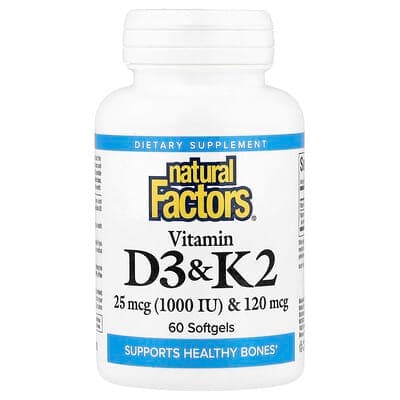
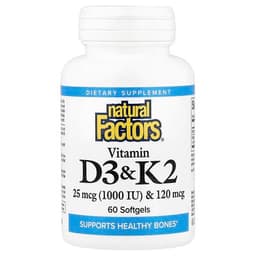
Natural Factors, Vitamin D3 & K2, 25 mcg (1,000 IU) & 120 mcg
Its weighted score is 8.15/10. ISURA certification, oil delivery and MK-7 outweigh its middling active-ingredient cost and below-trial doses.
Vitamin D3 + K2 Supplements ranked on form, dose, third-party testing and value per unit of active ingredient.
We may earn a commission when you buy through our links.

Its weighted score is 8.15/10. ISURA certification, oil delivery and MK-7 outweigh its middling active-ingredient cost and below-trial doses.

Its weighted score is 8.05/10. NSF certification and exceptional active-unit value nearly earn first place, but the MK-4 dose is far below the amount used in published MK-4 trials.

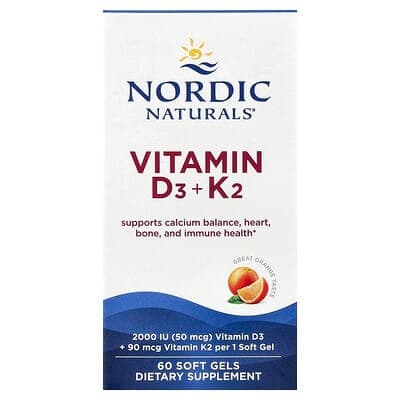
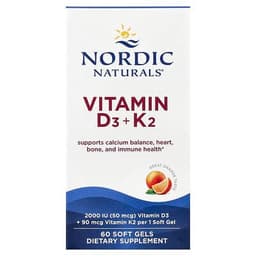
Its weighted score is 7.40/10. The research-comparable D3 dose, MK-7 and olive-oil delivery are strong, but its verification evidence is weaker than the two higher-ranked products.

Its weighted score is 6.45/10. It is the strongest vegan option in this group on source disclosure and value, but lacks an oil carrier and finished-product potency certification.

Its weighted score is 6.25/10. MenaQ7 and a research-comparable MK-7 dose are meaningful advantages, but limited verification, dry delivery and a long excipient list keep it fifth.
| Product | Third-Party Testing · 30% | Form & Bioavailability · 25% | Dose vs Research · 20% | Label Transparency · 15% | Value · 10% | Score | Price |
|---|---|---|---|---|---|---|---|
1Natural Factors, Vitamin D3 & K2, 25 mcg (1,000 IU) & 120 mcg | 9 | 9 | 7 | 8 | 6 | 8.2 | $20.97 |
2Thorne, Vitamin D + K2 Liquid, 1 fl oz (30 ml) | 10 | 7 | 4 | 10 | 10 | 8.1 | $34 |
3Nordic Naturals, Vitamin D3 + K2, Great Orange, 60 Soft Gels | 5 | 9 | 8 | 9 | 7 | 7.4 | $16.96 |
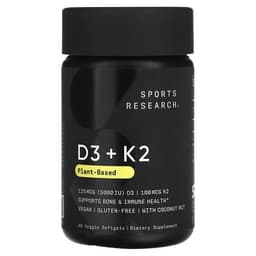
4MRM Nutrition, Vegan Vitamin D3 & K2, 60 Vegan Capsules | 3 | 8 | 7 | 9 | 8 | 6.5 | — |
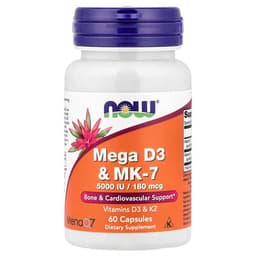
5Doctor's Best, Natural Vitamin K2 MK-7 plus D3, 180 mcg, 60 Veggie Caps | 3 | 8 | 8 | 7 | 7 | 6.3 | $23.99 |
| #1 | #2 | #3 | #4 | #5 | |
|---|---|---|---|---|---|
| Product | ![]() | ![]() | ![]() | ![]() | ![]() |
| Brand | Natural Factors | Thorne | Nordic Naturals | MRM Nutrition | Doctor's Best |
| D3 Per Serving | 25 mcg (1,000 IU) | 25 mcg (1,000 IU) | 50 mcg (2,000 IU) | 62.5 mcg (2,500 IU) | 25 mcg (1,000 IU) |
| K2 Per Serving | 120 mcg | 200 mcg | 90 mcg | 80 mcg | 180 mcg |
| K2 Form | MK-7 from natto bean | MK-4 (menatetrenone) | MK-7 (menaquinone-7) | MK-7 (menaquinone-7) | MK-7 from fermented chickpeas |
| K2 Brand | Not stated on label | Not stated on label | Not stated on label | Not stated on label | MenaQ7 |
| Delivery Form | Oil-based gelatin softgel with MCT oil | MCT-oil liquid; two drops per serving | Olive-oil-based gelatin softgel | Dry cellulose vegan capsule | Dry hypromellose vegetarian capsule |
| D3 Source | Cholecalciferol; source not disclosed on iHerb label | Cholecalciferol; source not disclosed on iHerb label | Cholecalciferol; source not disclosed on iHerb label | Lichen-derived VegaDELight; Certified Vegan | Cholecalciferol; source not disclosed on iHerb label |
| Third-Party Verification | ISURA Verified Clean certification | NSF/ANSI 173 Contents Certified | Label states 3rd Party Purity Tested and IGEN Non-GMO Tested; no public product-specific COA identified | Certified Vegan and Non-GMO Project Verified; neither verifies D3/K2 potency | No recognized finished-product certification or public product-specific COA identified |
| Active Cost | $0.350 per 1,000 IU D3; $0.291 per 100 mcg K2 | $0.057 per 1,000 IU D3; $0.028 per 100 mcg K2 | $0.141 per 1,000 IU D3; $0.314 per 100 mcg K2 | $0.091 per 1,000 IU D3; $0.283 per 100 mcg K2 | $0.400 per 1,000 IU D3; $0.222 per 100 mcg K2 |
| Price | $20.97 | $34 | $16.96 | — | $23.99 |
Start with the Supplement Facts panel, not the front-label dose or bottle count. Compare the amount per serving and confirm whether one serving is one capsule, multiple capsules or several drops. For vitamin D, every product here uses D3, or cholecalciferol. The NIH lists 600 IU daily as the adult RDA through age 70 and 800 IU after age 70, while the large VITAL human trial used 2,000 IU of D3 per day. These are comparison anchors, not proof that 2,000 IU is the correct personal dose. The adult tolerable upper intake level is 4,000 IU daily from all sources, so a 5,000 IU product should not automatically be considered better. Total intake and measured 25-hydroxyvitamin D should guide individualized decisions with a qualified clinician. For K2, distinguish MK-7 from MK-4. Human pharmacokinetic work indicates that MK-7 is retained in circulation longer than MK-4, making microgram once-daily formulas practical. A three-year MK-7 trial used 180 mcg daily. By contrast, published MK-4 trials commonly used 45 mg daily, or 45,000 mcg, so a product containing 200 mcg of MK-4 should not be described as matching that research dose. Branded forms such as MenaQ7 identify a standardized ingredient source, but the ingredient trademark does not independently certify the finished bottle. Delivery form also matters because D3 and K2 are fat-soluble. Oil-based drops and softgels supply a lipid carrier directly. A dry capsule can still be a reasonable choice when its directions specify taking it with food, but buyers should not assume that a vegetable capsule contains oil. Likewise, a vegetarian capsule does not prove the D3 is vegan: strict vegans should look for an explicitly disclosed lichen-derived D3 source and a vegan certification. Give the highest testing credit to finished-product certifications such as USP or NSF, or to a publicly available product-specific certificate of analysis. A cGMP facility, Non-GMO verification or an unspecified third-party-tested statement is not equivalent to independent confirmation of the active amounts. ISURA certification is relevant because its published standard covers finished-product potency, label integrity and contaminant screening. Check transparency for the exact K2 form, D3 source, all active doses, allergens and every excipient. Avoid proprietary blends, undisclosed K forms, unexplained high-potency D3 and products that substitute capsule count for serving count. Common mistakes include ranking solely by price per bottle, assuming more D3 is always preferable, treating MK-4 and MK-7 doses as interchangeable, and overlooking anticoagulant interactions. Vitamin K intake requires particular care for people using warfarin or another vitamin-K-antagonist medication.
We rank on third-party testing (30%), form and bioavailability (25%), dose versus published human research (20%), label transparency (15%) and value per unit of active ingredient (10%). Specifications are taken from each product's supplement facts panel on its iHerb listing, and certification claims are checked against the certifying body's directory where one is published. We do not test products ourselves, and nothing here is medical advice.
Independent certification or a published certificate of analysis
Whether the chemical form is the well-absorbed one
Per-serving dose versus doses used in published human trials
Full per-ingredient disclosure and minimal fillers
Cost per unit of active ingredient