Methylcobalamin B12 for Vegans ranked on form, dose, third-party testing and value per unit of active ingredient.
Updated August 5, 20265 rankedNo paid placements
We may earn a commission when you buy through our links. Prices and availability shown are accurate as of Aug 5, 2026 and are subject to change; the merchant's price at purchase applies.
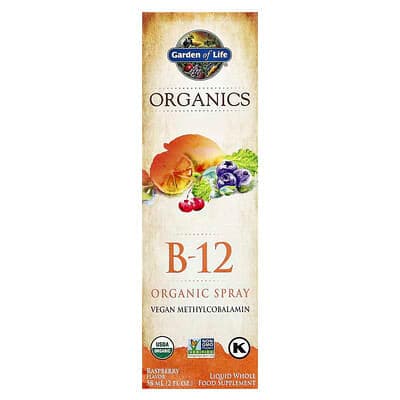
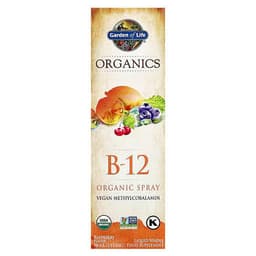
It ranks first because its certified-vegan status, transparent label, and comparatively moderate 500 mcg dose outweigh its higher cost per unit of active B12. The absence of finished-product potency certification prevents a higher testing score.
500 mcg per spray is the lowest labeled daily B12 dose among the five and is closer than the 1,000–2,500 mcg products to doses used in vegetarian-focused daily protocols.Vegan Action, USDA Organic/QCS, Non-GMO Project, and GFCO certifications provide independently verifiable dietary and sourcing credentials.One bottle contains 140 single-spray servings and the label fully discloses the 22-component organic food blend.No USP, NSF, Informed Choice, or public product-specific B12 potency certificate was found; its named certifications do not verify the labeled B12 amount.The label requires refrigeration after opening and use within 90 days, although the bottle contains 140 daily servings.
Its transparent vegan formula, low active-ingredient cost, and lot-COA portal produce the second-highest weighted score. Its exceptionally high review and sales counts break the close comparison with similarly formulated products but do not override the testing limitations.
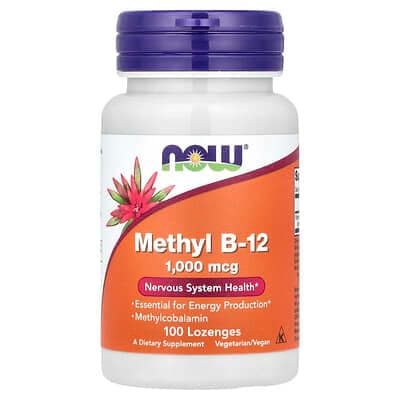
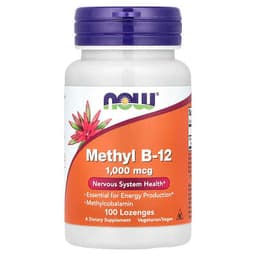
Provides 1,000 mcg methylcobalamin in a chewable or dissolvable vegan lozenge.Costs about $0.08 per serving and $0.08 per 1,000 mcg of active B12.NOW supplies a lot-number certificate-of-analysis lookup and lists Intertek GMP certification, while iHerb reports more than 10,000 units sold in 30 days.A pre-purchase public product-specific certificate is not available without a bottle lot number, and GMP certification is not equivalent to independent finished-product certification.Contains xylitol and natural flavors; the label warns that xylitol is harmful to pets.
It ranks third on exceptional value and a straightforward 1,000 mcg formula. NOW ranks above it because NOW provides stronger pre-purchase transparency through its COA portal and has substantially more buyer-history evidence.
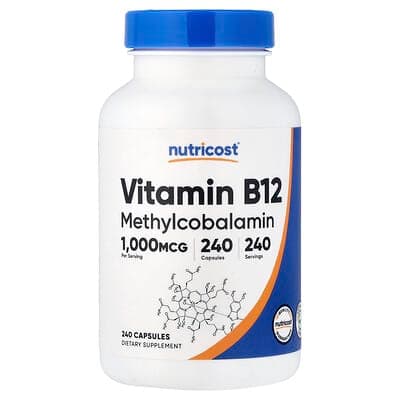
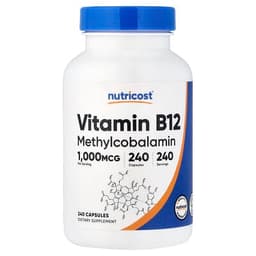
The 240-serving bottle costs about $0.06 per serving and $0.062 per 1,000 mcg of B12, the lowest active-ingredient cost among the 1,000 mcg products.Uses methylcobalamin in a cellulose capsule without gelatin.Nutricost states that the product is evaluated by independent ISO-accredited laboratories.No public product-specific certificate for this SKU was found, so the independent-laboratory statement cannot be checked against a reported batch result.It is a swallowed capsule rather than a lozenge or spray, and the manufacturer describes it as vegetarian-friendly while iHerb supplies the explicit vegan classification.
Strong vegan verification and excellent value place it fourth despite limited finished-product testing evidence. Its 2,500 mcg labeled daily dose scores lower against the cited human dosing protocols than the 500–1,000 mcg options.
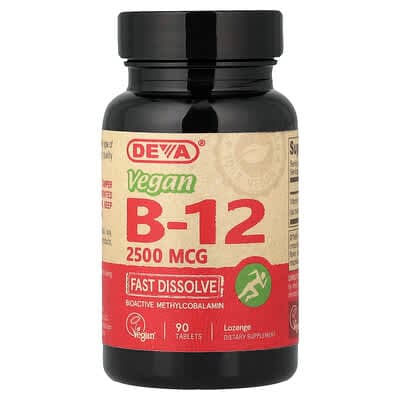
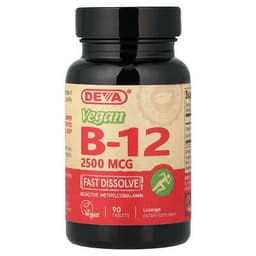
Registered with the Vegan Society, with an explicit label statement excluding animal products, byproducts, and derivatives.Provides 2,500 mcg methylcobalamin in a dissolve-in-mouth tablet.Costs about $0.055 per 1,000 mcg of active B12, the lowest unit cost in the list.The labeled daily dose is higher than the 1,000–2,000 mcg daily doses used in many high-dose oral trials and far above the daily amount in the vegan-specific trial.No USP, NSF, Informed Choice, or public product-specific potency certificate was found.
Its unusually short inactive-ingredient list and extensive buyer history earn the final position. It ranks below Deva because it lacks named vegan certification and offers weaker value per unit of active B12.
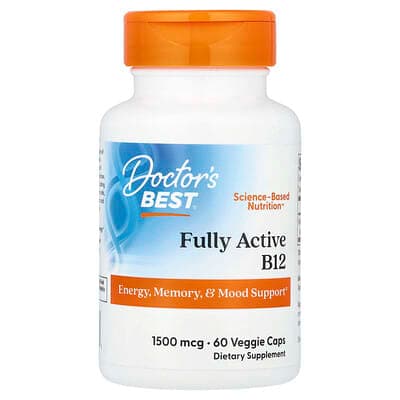
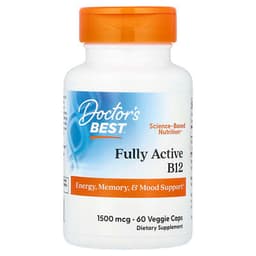
Minimal inactive formula containing only microcrystalline cellulose and a hypromellose capsule.Explicitly labeled vegan, non-GMO, gluten-free, and soy-free on iHerb.Provides 1,500 mcg per serving at about $0.10 per 1,000 mcg, with more than 28,000 iHerb reviews.No USP, NSF, Informed Choice, or public product-specific certificate of analysis was found.The capsule must be swallowed and provides no lozenge, sublingual, or liquid option.
Doctor's Best, Fully Active B12, 1,500 mcg, 60 Veggie Caps
Brand
Garden of Life
NOW Foods
Nutricost
Deva
Doctor's Best
B12 per serving
500 mcg
1,000 mcg
1,000 mcg
2,500 mcg
1,500 mcg
B12 form
Methylcobalamin from Saccharomyces cerevisiae
Methylcobalamin
Methylcobalamin
Methylcobalamin
Methylcobalamin
Delivery route
One oral spray
Chew or dissolve in the mouth, then swallow
Swallow one capsule with water
Dissolve one tablet in the mouth before swallowing
Swallow one capsule with a meal
Servings per container
140
100
240
90
60
Added folate
None
None
None
None
None
Added vitamin B6
None
None
None
None
None
Other ingredients and allergens
Water, organic glycerin, juices, flavors, stevia, and rice; made without dairy, soy, wheat, peanut, fish, or shellfish; shared allergen-processing facility
Xylitol, celluloses, citric acid, vegetable-source stearic acid, natural flavors, stevia, and monk fruit; no listed major allergens, but made in a shared facility
Rice flour, dicalcium phosphate, and hypromellose cellulose capsule; iHerb lists gluten-free and non-GMO
Mannitol, xylitol, crospovidone, vegetable stearic acid, silica, lemon flavor, citric acid, sodium citrate, and vegetable magnesium stearate; free of yeast, soy, gluten, and wheat
Microcrystalline cellulose and hypromellose capsule; labeled gluten-free and soy-free
Start with verified vegan suitability, not the words “veggie capsule” or “vegetarian.” Gelatin is an obvious exclusion, but lactose, milk-derived excipients, and ingredients with ambiguous sourcing can also disqualify a product. Named verification from Vegan Action or the Vegan Society is stronger evidence than an unsupported plant-based claim. The entire label still matters because vegan certification does not establish vitamin potency or contaminant limits. Methylcobalamin and adenosylcobalamin are coenzyme forms of B12. Cyanocobalamin requires conversion and is excluded from this list because of the specified search intent, but that should not be interpreted as proof that methylcobalamin is universally better absorbed; cyanocobalamin is stable and has a broader body of dosing evidence. Likewise, sprays, lozenges, and fast-dissolve tablets can be easier to take, but controlled research has not established a consistent absorption advantage over swallowed tablets. Choose the delivery format most likely to be used consistently. Dose and frequency must be considered together. A 12-week randomized trial in vegans and vegetarians with marginal B12 status compared sublingual cyanocobalamin at 50 mcg daily with 2,000 mcg once weekly. Other human studies involving low B12 status have used oral doses of 1,000 or 2,000 mcg daily, including a trial using 1,000 mcg daily methylcobalamin after gastric bypass. These populations and protocols are not interchangeable with routine supplementation for every vegan. The products here provide 500–2,500 mcg per labeled daily serving, so a larger percentage of Daily Value is not automatically preferable. Baseline intake, fortified foods, laboratory results, frequency, and professional guidance should determine an appropriate schedule. For quality evidence, prioritize a product-level USP, NSF, Informed Choice, or comparable certification, or a publicly available product-specific certificate of analysis. A GMP facility certificate evaluates manufacturing controls; it is not equivalent to independent verification of the finished product’s B12 amount. Vegan, organic, Non-GMO, and gluten-free certifications verify different attributes and should not be presented as potency testing. None of these five provides the strongest possible combination of public product-specific potency and contaminant documentation, so their testing scores remain restrained. Check whether folate or B6 is included. None of the five selected products adds either nutrient, which makes their B12 dose easier to compare and avoids unintentionally duplicating a multivitamin. Prefer labels that disclose every active amount and all inactive ingredients. Compare value per 1,000 mcg of B12 rather than bottle price alone, but also consider whether the labeled serving frequency is appropriate. Common mistakes include assuming sublingual automatically means superior absorption, treating very high potency as inherently better, overlooking refrigeration or use-after-opening instructions, and confusing buyer popularity with independent quality verification.
We rank on third-party testing (30%), form and bioavailability (25%), dose versus published human research (20%), label transparency (15%) and value per unit of active ingredient (10%). Specifications are taken from each product's supplement facts panel on its iHerb listing, and certification claims are checked against the certifying body's directory where one is published. We do not test products ourselves, and nothing here is medical advice.
Third-Party Testing
Independent certification or a published certificate of analysis
30%
Form & Bioavailability
Whether the chemical form is the well-absorbed one
25%
Dose vs Research
Per-serving dose versus doses used in published human trials
20%
Label Transparency
Full per-ingredient disclosure and minimal fillers
Is methylcobalamin or adenosylcobalamin better absorbed than other B12 forms?
Methylcobalamin and adenosylcobalamin are coenzyme forms, but published evidence does not establish that either is universally better absorbed or more effective than cyanocobalamin. This comparison excludes cyanocobalamin because of the requested product filter, not because methylcobalamin has proven universal superiority.
How does the labeled dose compare with doses used in human research?
A vegan-and-vegetarian trial compared sublingual cyanocobalamin at 50 mcg daily with 2,000 mcg once weekly. Other trials involving low B12 status have used 1,000–2,000 mcg daily, including 1,000 mcg daily methylcobalamin in a post-gastric-bypass study. Because baseline status and study populations differ, those protocols should not be treated as a universal personal dose.
Does a sublingual lozenge or spray absorb better than a swallowed capsule?
Controlled comparisons have not shown a consistent clinical advantage for sublingual delivery over swallowed oral B12. Lozenges and sprays can still be practical for people who dislike capsules, while a capsule may be preferable for avoiding flavors and sugar alcohols.
What third-party evidence should a buyer look for?
Look for a product-level USP, NSF, Informed Choice, or comparable certification, or a publicly available product-specific certificate reporting identity, potency, and contaminants. GMP, vegan, organic, Non-GMO, and gluten-free credentials verify narrower claims and should not be treated as proof that the labeled B12 amount was independently confirmed.