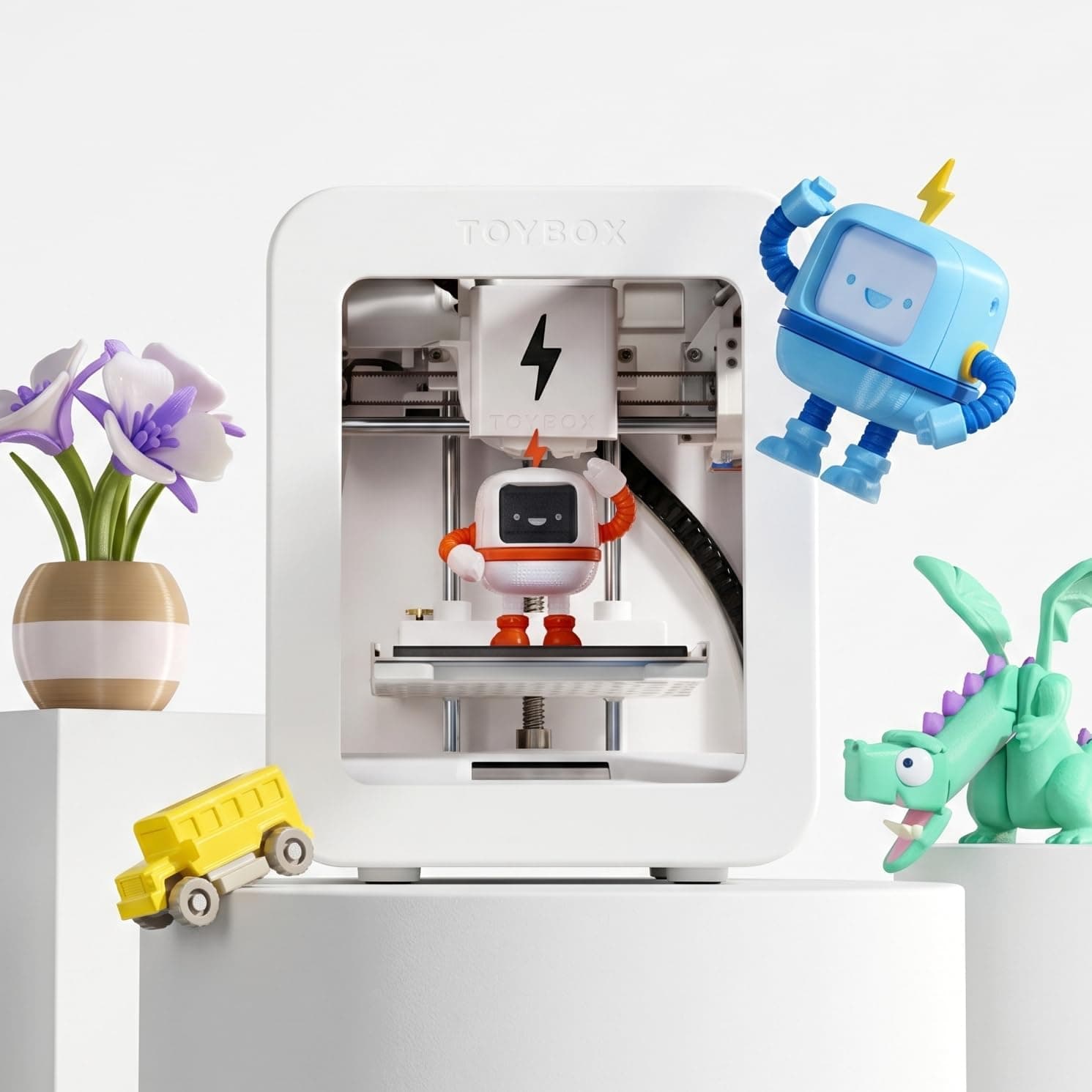
Toybox Alpha Three 3D Printer
Toybox is the printer built for young children, and Popular Science and 3DPrintGearLab both name it their pick for the youngest makers (3DPrintGearLab and GeekBitz put it at about ages 5 to 8). There is no slicer and no bed leveling: a child picks a toy from the app's catalog on a phone or tablet and the Alpha Three prints it over Wi-Fi, in plant-based PLA, with no heated bed. The cost of that simplicity is size and flexibility. Its 75 × 80 × 90 mm build area is tiny, Toybox's own filament rolls and Pro membership are pushed hard, and reviewers expect most kids to outgrow it by about age 10 or 11.
We may earn a commission when you buy through our links.
Our Verdict
The easiest printer here and the right one for children of about five to eight, the age band 3DPrintGearLab and GeekBitz give it and the reason Popular Science named Toybox its top kids' pick: a child chooses a toy in the app and prints it over Wi-Fi, with no slicer, leveling or heated bed, in an enclosed print area. It ranks third because its 75 × 80 × 90 mm build area is tiny, it is PLA-only with Toybox's own rolls and Pro membership pushed hard, and reviewers expect most kids to outgrow it by about age 10 or 11. It ranks above the full-size Bambu Lab A1 for this list because, for a young child, its enclosed, unheated design and app-only workflow matter more than the A1's far larger and better-quality prints.
Score Breakdown
Pros & Cons
Pros
- •The simplest workflow here: pick a toy in the app and print, with no slicer, calibration or leveling
- •Enclosed print area and no heated bed, which suits younger children
- •Large catalog of ready-to-print toys in the Toybox app
- •Compact and light (2.4 kg), easy to move to a kitchen table
Cons
- •Tiny 75 × 80 × 90 mm build area limits prints to small toys
- •PLA only, with Toybox pushing its own filament rolls and a paid Pro membership
- •Reviewers expect most kids to outgrow it by around age 10 or 11; GeekBitz also notes owner reports of Wi-Fi drops and clogs
Specifications
| Recommended Age | About 5–8 (per 3DPrintGearLab and GeekBitz) |
| Build Volume | 75 × 80 × 90 mm |
| Enclosure | Enclosed print area |
| Setup & Calibration | Plug and play; no bed leveling or slicer |
| How Kids Print | Toybox phone/tablet app with a built-in toy catalog |
| Connectivity | Wi-Fi (2.4 GHz) |
| Max Speed | About 240 mm/s typical (manufacturer figure) |
| Filaments | PLA only (Toybox rolls recommended) |
| Max Bed Temp | No heated bed |
| Layer Height | 0.2 mm default |
| Weight | 2.4 kg |
| Dimensions | 7.5 × 7.75 × 9.5 in |
Quick Answers
What is the recommended age of the Toybox Alpha Three 3D Printer?
Toybox Alpha Three 3D Printer recommended age: About 5–8 (per 3DPrintGearLab and GeekBitz).
What is the build volume of the Toybox Alpha Three 3D Printer?
Toybox Alpha Three 3D Printer build volume: 75 × 80 × 90 mm.
What is the enclosure of the Toybox Alpha Three 3D Printer?
Toybox Alpha Three 3D Printer enclosure: Enclosed print area.
What is the setup & calibration of the Toybox Alpha Three 3D Printer?
Toybox Alpha Three 3D Printer setup & calibration: Plug and play; no bed leveling or slicer.
What is the how kids print of the Toybox Alpha Three 3D Printer?
Toybox Alpha Three 3D Printer how kids print: Toybox phone/tablet app with a built-in toy catalog.
What is the connectivity of the Toybox Alpha Three 3D Printer?
Toybox Alpha Three 3D Printer connectivity: Wi-Fi (2.4 GHz).
What is the max speed of the Toybox Alpha Three 3D Printer?
Toybox Alpha Three 3D Printer max speed: About 240 mm/s typical (manufacturer figure).
What is the filaments of the Toybox Alpha Three 3D Printer?
Toybox Alpha Three 3D Printer filaments: PLA only (Toybox rolls recommended).
Who is the Toybox Alpha Three 3D Printer for?
It suits children about 5 to 8, parents who want zero setup and no computer, printing small toys and figurines. It is not the right pick for tweens and teens who will want bigger or more complex prints, anyone who wants to use cheap third-party filament freely.
Is the Toybox Alpha Three 3D Printer worth buying?
Toybox is the printer built for young children, and Popular Science and 3DPrintGearLab both name it their pick for the youngest makers (3DPrintGearLab and GeekBitz put it at about ages 5 to 8). There is no slicer and no bed leveling: a child picks a toy from the app's catalog on a phone or tablet and the Alpha Three prints it over Wi-Fi, in plant-based PLA, with no heated bed. The cost of that simplicity is size and flexibility. Its 75 × 80 × 90 mm build area is tiny, Toybox's own filament rolls and Pro membership are pushed hard, and reviewers expect most kids to outgrow it by about age 10 or 11. It ranks #3 in our Top 5 3D Printers for Kids. The easiest printer here and the right one for children of about five to eight, the age band 3DPrintGearLab and GeekBitz give it and the reason Popular Science named Toybox its top kids' pick: a child chooses a toy in the app and prints it over Wi-Fi, with no slicer, leveling or heated bed, in an enclosed print area. It ranks third because its 75 × 80 × 90 mm build area is tiny, it is PLA-only with Toybox's own rolls and Pro membership pushed hard, and reviewers expect most kids to outgrow it by about age 10 or 11. It ranks above the full-size Bambu Lab A1 for this list because, for a young child, its enclosed, unheated design and app-only workflow matter more than the A1's far larger and better-quality prints.
Who Is This For?
Best For
- Children about 5 to 8
- Parents who want zero setup and no computer
- Printing small toys and figurines
Not For
- Tweens and teens who will want bigger or more complex prints
- Anyone who wants to use cheap third-party filament freely
Where to Buy
Appears In
Compare Head-to-Head
Customer Reviews
Alternatives to Consider
Bambu Lab A1 mini
Bambu Lab
Bambu Lab's compact open-frame printer is the pick most kids' 3D printer roundups land on for children of about nine and up: Tom's Hardware ranks it first for kids and teens, 3DPrintGearLab names it best overall and GeekBitz calls it the strongest overall pick. It sets up in roughly 15 minutes, calibrates itself, prints a 180 mm cube at up to 500 mm/s and runs under 48 dB in silent mode, and the Bambu Handy app sends ready-made MakerWorld models to it from a phone. The trade-off for a family is the open frame: the hot nozzle and moving bed are exposed, so reviewers advise adult supervision for younger children. Amazon sells it bundled with Bambu Lab's LED Lamp Kit.
Flashforge Adventurer 5M Pro
Flashforge
The Adventurer 5M Pro is the enclosed choice in this list: an acrylic door and lid close off the hot nozzle and moving parts, and HEPA plus activated-carbon filtration treats the air inside, which Flashforge pitches at study rooms and classrooms. It is a CoreXY printer rated at up to 600 mm/s over a 220 mm cube, with one-click auto leveling, a 4.3-inch touchscreen, a built-in camera and tool-free nozzle swaps. Anton Mansson's review calls it a great package for enthusiasts and beginners, while noting it is louder than he would like and that Flashforge's own FlashPrint slicer has thin material profiles. It suits teenagers, or a household that wants the printer's hot parts behind a door.
Bambu Lab A1
Bambu Lab
The full-size A1 is the A1 mini's bigger sibling and 3DPrintGearLab's 'best to grow into' pick for about ages 10 and up. It keeps the mini's full-auto calibration, phone printing and under-48 dB silent mode, but prints a 256 mm cube, more than 2.8 times the mini's volume, and its bed reaches 100°C. That makes it the better buy for a tween or teen who will move on to helmets, cosplay parts or school projects. It shares the mini's open bed-slinger frame, needs more desk space and costs more, which is why it sits below the mini for most families. This is the printer-only listing; the four-color A1 Combo is ranked in our multi-color list.
Creality Ender-3 V3 SE
Creality
The Ender-3 V3 SE is the budget teen pick in 3DPrintGearLab's and GeekBitz's kids' guides and the cheapest printer here. It prints a 220 × 220 × 250 mm volume at up to 250 mm/s, levels its bed with a CR Touch probe, and its Sprite direct-drive extruder handles flexible TPU as well as PLA and PETG. It is also the most hands-on printer in this list: it needs some assembly, has no Wi-Fi (files go on a microSD card from a desktop slicer) and uses a dial-driven 3.2-inch screen. For a teenager who wants to learn how a printer works, that is part of the appeal; for a younger child, it is a reason to choose one of the picks above.