Toybox Alpha Three 3D Printer vs Bambu Lab A1
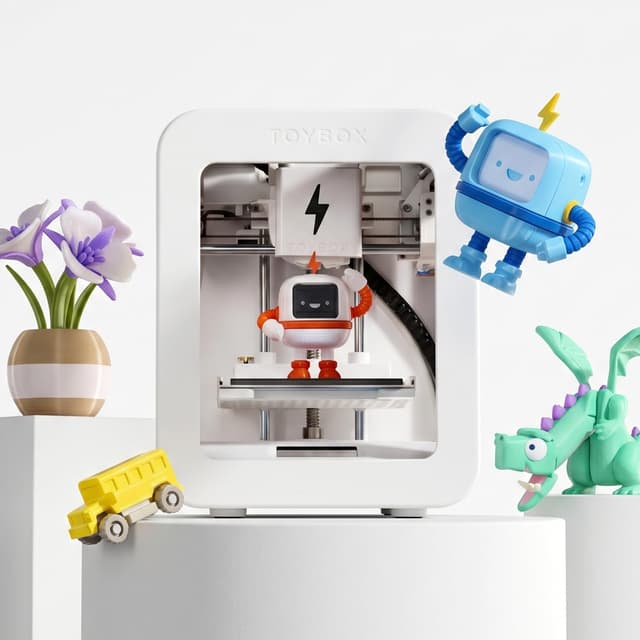
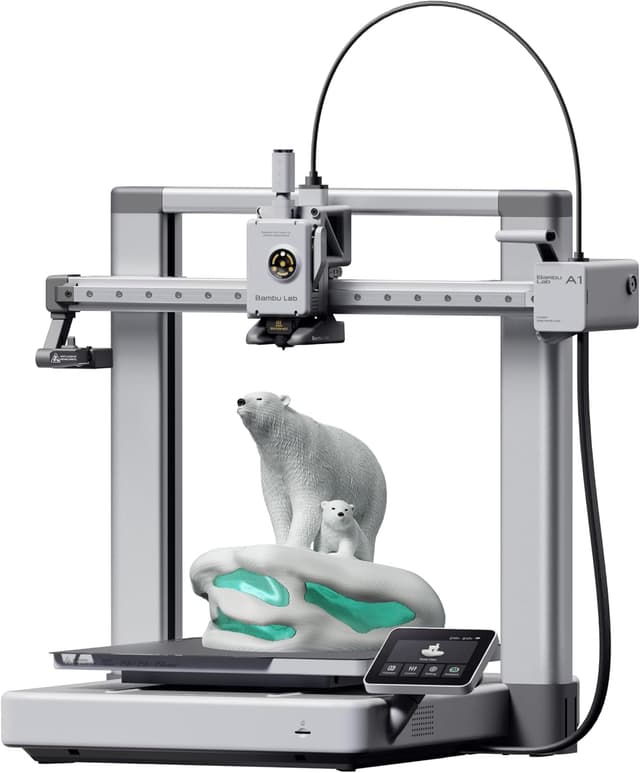
Toybox Alpha Three 3D Printer (#3) vs Bambu Lab A1 (#4): in our 3D Printers for Kids scoring the Toybox Alpha Three 3D Printer totals 7.3/10 and the Bambu Lab A1 7.2/10.
We may earn a commission when you buy through our links.
TopsFive comparison scores
Side by side
| Toybox Alpha Three 3D Printer | Bambu Lab A1 | |
|---|---|---|
| Recommended Age | About 5–8 (per 3DPrintGearLab and GeekBitz) | About 10+ (per 3DPrintGearLab) |
| Build Volume | 75 × 80 × 90 mm | 256 × 256 × 256 mm |
| Enclosure | Enclosed print area | Open frame (bed slinger) |
| Setup & Calibration | Plug and play; no bed leveling or slicer | About 15–20 minutes; full-auto calibration |
| How Kids Print | Toybox phone/tablet app with a built-in toy catalog | Bambu Handy phone app or touchscreen, MakerWorld model library |
| Connectivity | Wi-Fi (2.4 GHz) | Wi-Fi, microSD |
| Max Speed | About 240 mm/s typical (manufacturer figure) | 500 mm/s |
| Filaments | PLA only (Toybox rolls recommended) | PLA, PETG, TPU |
| Max Bed Temp | No heated bed | 100°C |
| Layer Height | 0.2 mm default | — |
| Weight | 2.4 kg | — |
| Dimensions | 7.5 × 7.75 × 9.5 in | — |
| Max Nozzle Temp | — | 300°C |
| Noise | — | Under 48 dB in silent mode |
| Upgrade Path | — | AMS lite for 4-color printing |
| Price | Check price → | Check price → |
How they differ in real use
Built from our 3d printers for kids scoring, each product's published specifications, and verified owner feedback — not hands-on testing.
Both the Toybox Alpha Three 3D Printer and the Bambu Lab A1 made our Top 5 3D Printers for Kids, at #3 and #4. The easiest printer here and the right one for children of about five to eight, the age band 3DPrintGearLab and GeekBitz give it and the reason Popular Science named Toybox its top kids' pick: a child chooses a toy in the app and prints it over Wi-Fi, with no slicer, leveling or heated bed, in an enclosed print area. It ranks third because its 75 × 80 × 90 mm build area is tiny, it is PLA-only with Toybox's own rolls and Pro membership pushed hard, and reviewers expect most kids to outgrow it by about age 10 or 11. It ranks above the full-size Bambu Lab A1 for this list because, for a young child, its enclosed, unheated design and app-only workflow matter more than the A1's far larger and better-quality prints. The printer to grow into, and 3DPrintGearLab's pick for that role at about age 10 and up: the same full-auto calibration, phone app and under-48 dB silent mode as the A1 mini, but a 256 mm cube (about 2.9 times the mini's volume) and a 100°C bed, so a tween or teen can print helmets, cosplay pieces and school projects in one piece. It ranks below the A1 mini because most children do not need the extra size, and the larger moving bed and footprint make it harder to place and supervise in a child's room. It ranks above the Creality Ender-3 V3 SE because it needs no tinkering, prints from a phone over Wi-Fi and adds four-color printing with an AMS lite, which justifies the extra cost over the Ender.
We score 3d printers for kids on Ease of Use for Kids (25%), Safety (20%), Print Quality & Reliability (20%), Room to Grow (10%), Noise & Home Fit (10%) and Value (15%). On that basis the Toybox Alpha Three 3D Printer totals 7.3 out of 10 and the Bambu Lab A1 7.2. The widest gap is Safety, where the Toybox Alpha Three 3D Printer scores 9 against 4 for the Bambu Lab A1: how well the design keeps children away from hazards: enclosure or exposed hot nozzle and moving bed, heated-bed temperature, and air filtration. Print Quality & Reliability also separates them: 9 for the Bambu Lab A1 versus 5 for the Toybox Alpha Three 3D Printer. The Bambu Lab A1 claws back ground on Room to Grow and Value.
On paper, the specifications that actually differ: Recommended Age: About 5–8 (per 3DPrintGearLab and GeekBitz) on the Toybox Alpha Three 3D Printer versus About 10+ (per 3DPrintGearLab) on the Bambu Lab A1; Build Volume: 75 × 80 × 90 mm on the Toybox Alpha Three 3D Printer versus 256 × 256 × 256 mm on the Bambu Lab A1; Enclosure: Enclosed print area on the Toybox Alpha Three 3D Printer versus Open frame (bed slinger) on the Bambu Lab A1; Setup & Calibration: Plug and play; no bed leveling or slicer on the Toybox Alpha Three 3D Printer versus About 15–20 minutes; full-auto calibration on the Bambu Lab A1; How Kids Print: Toybox phone/tablet app with a built-in toy catalog on the Toybox Alpha Three 3D Printer versus Bambu Handy phone app or touchscreen, MakerWorld model library on the Bambu Lab A1; Connectivity: Wi-Fi (2.4 GHz) on the Toybox Alpha Three 3D Printer versus Wi-Fi, microSD on the Bambu Lab A1.
Check current pricing at the merchant links below. Owners praise the Toybox Alpha Three 3D Printer for the simplest workflow here: pick a toy in the app and print, with no slicer, calibration or leveling and enclosed print area and no heated bed, which suits younger children; the most common complaint is tiny 75 × 80 × 90 mm build area limits prints to small toys. Owners praise the Bambu Lab A1 for 256 mm cube build volume, the largest in this list and same full-auto calibration, Bambu Handy app and MakerWorld library as the A1 mini; the most common complaint is open frame with an exposed hot nozzle and a large moving bed; supervise younger children.
Toybox Alpha Three 3D Printer
- The simplest workflow here: pick a toy in the app and print, with no slicer, calibration or leveling
- Enclosed print area and no heated bed, which suits younger children
- Large catalog of ready-to-print toys in the Toybox app
- Compact and light (2.4 kg), easy to move to a kitchen table
- Tiny 75 × 80 × 90 mm build area limits prints to small toys
- PLA only, with Toybox pushing its own filament rolls and a paid Pro membership
- Reviewers expect most kids to outgrow it by around age 10 or 11; GeekBitz also notes owner reports of Wi-Fi drops and clogs
Bambu Lab A1
- 256 mm cube build volume, the largest in this list
- Same full-auto calibration, Bambu Handy app and MakerWorld library as the A1 mini
- Rated under 48 dB in silent mode
- Adds four-color printing later with an AMS lite
- Open frame with an exposed hot nozzle and a large moving bed; supervise younger children
- Bigger footprint than the A1 mini needs a sturdy, deep desk
- Costs more than the A1 mini for a size a younger child rarely needs
Which should you buy?
The Toybox Alpha Three 3D Printer is the better fit for children about 5 to 8 and parents who want zero setup and no computer; it is the higher-scoring pick here, chiefly for Safety and Ease of Use for Kids. The Bambu Lab A1 is the better fit for tweens and teens ready for larger prints and cosplay, school and maker projects, and the stronger choice if Print Quality & Reliability and Room to Grow matter more to you than the overall score. The Toybox Alpha Three 3D Printer is a poor fit for tweens and teens who will want bigger or more complex prints; the Bambu Lab A1 is a poor fit for small desks.
Choose the Toybox Alpha Three 3D Printer if
- Children about 5 to 8
- Parents who want zero setup and no computer
- Printing small toys and figurines
Skip it if
- Tweens and teens who will want bigger or more complex prints
- Anyone who wants to use cheap third-party filament freely
Choose the Bambu Lab A1 if
- Tweens and teens ready for larger prints
- Cosplay, school and maker projects
- Families who want one printer for kids and adults
Skip it if
- Small desks
- Young children printing unsupervised
Common questions
Is the Toybox Alpha Three 3D Printer better than the Bambu Lab A1?
In our 3D Printers for Kids ranking the Toybox Alpha Three 3D Printer scores higher overall, 7.3 to 7.2, with the biggest advantage in Safety. The Bambu Lab A1 is stronger on Print Quality & Reliability and Room to Grow, so it is the better pick if those matter most to you.
What is the main difference between the Toybox Alpha Three 3D Printer and the Bambu Lab A1?
The headline spec difference is Recommended Age: About 5–8 (per 3DPrintGearLab and GeekBitz) on the Toybox Alpha Three 3D Printer versus About 10+ (per 3DPrintGearLab) on the Bambu Lab A1. In use, the gap that matters most is Safety (9 vs 4 in our scoring): how well the design keeps children away from hazards: enclosure or exposed hot nozzle and moving bed, heated-bed temperature, and air filtration.