Logitech Wave Keys
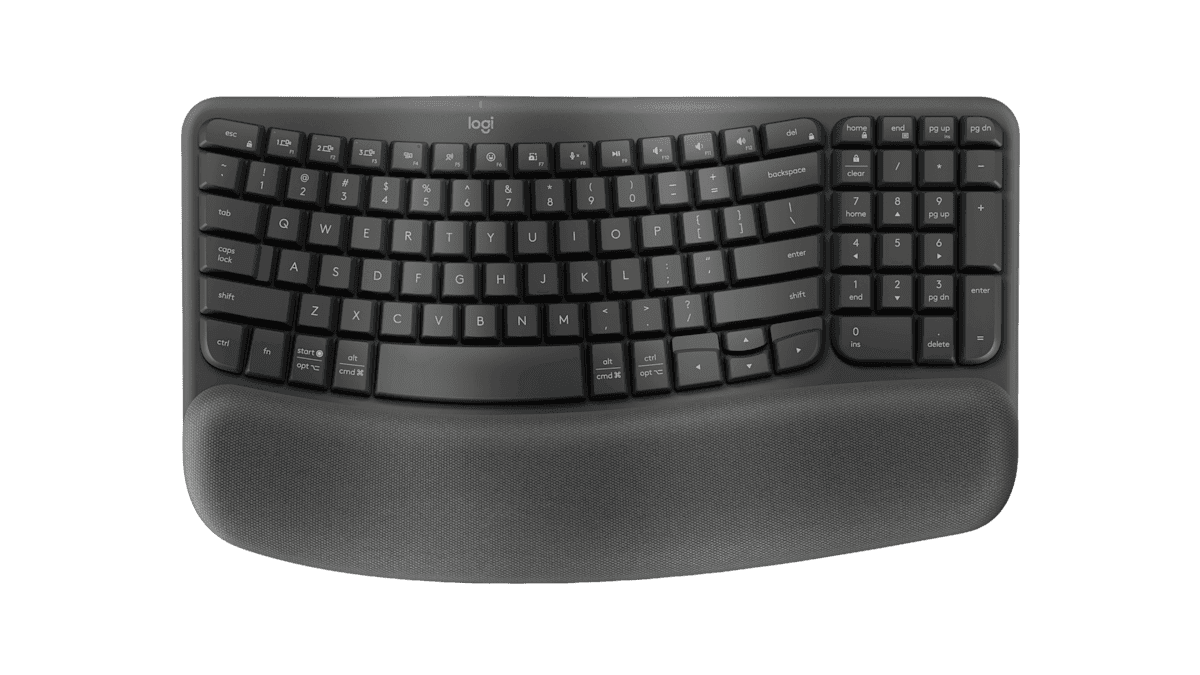
The best budget entry point, and the gentlest way to start easing wrist strain for around $60. The Wave Keys is not a split keyboard. It is a compact one-piece board with a wave-shaped key layout that follows the natural curve of the fingertips, paired with a cushioned three-layer memory-foam palm rest that keeps the wrists supported and neutral. It is the mildest ergonomic intervention on this list, so it suits early or mild symptoms rather than diagnosed carpal tunnel, but it asks for zero relearning and earns a 4.3-star average from thousands of owners. Connectivity is wireless over Bluetooth or Logitech's Bolt receiver, and the footprint is small enough for tight desks. Think of it as a low-risk first step before committing to a full split or contoured design.
We may earn a commission when you buy through our links.
Our Verdict
The budget pick and the gentlest starting point, best for early or mild symptoms and prevention. Its wave-shaped one-piece layout and cushioned memory-foam palm rest support a neutral wrist for around $60 with zero relearning. It ranks last because it is the mildest intervention here (not a true split and without tenting), so it does less for the wrist than the picks above, but as a low-risk first step it is hard to beat on price.
Score Breakdown
Pros & Cons
Pros
- •Wave-shaped keys and cushioned palm rest support a neutral wrist
- •Around $60, the most affordable pick here
- •Compact one-piece design suits tight desks
- •Wireless via Bluetooth or Logi Bolt, multi-device Easy-Switch
- •4.3-star average from thousands of owners; no learning curve
Cons
- •Not a true split, the mildest ergonomic intervention here
- •No tenting and only a shallow wrist angle versus the K860
- •Integrated palm rest is not removable
Specifications
| Layout Type | Wave-shaped (one-piece) |
| Split Design | None (integrated wave) |
| Tenting | None |
| Wrist Rest | Cushioned, integrated |
| Switch Type | Quiet membrane |
| Connectivity | Bluetooth + Logi Bolt |
| Programmable | Logi Options+ remap |
| Numpad | Yes (full size) |
Quick Answers
What is the layout type of the Logitech Wave Keys?
Logitech Wave Keys layout type: Wave-shaped (one-piece).
What is the split design of the Logitech Wave Keys?
Logitech Wave Keys split design: None (integrated wave).
What is the tenting of the Logitech Wave Keys?
Logitech Wave Keys tenting: None.
What is the wrist rest of the Logitech Wave Keys?
Logitech Wave Keys wrist rest: Cushioned, integrated.
What is the switch type of the Logitech Wave Keys?
Logitech Wave Keys switch type: Quiet membrane.
What is the connectivity of the Logitech Wave Keys?
Logitech Wave Keys connectivity: Bluetooth + Logi Bolt.
What is the programmable of the Logitech Wave Keys?
Logitech Wave Keys programmable: Logi Options+ remap.
What is the numpad of the Logitech Wave Keys?
Logitech Wave Keys numpad: Yes (full size).
Who is the Logitech Wave Keys for?
It suits early or mild symptoms and prevention, budget buyers who want a low-risk first step, tight desks that can't fit a split keyboard. It is not the right pick for diagnosed or moderate-to-severe carpal tunnel, anyone who needs a genuine split or tenting.
Is the Logitech Wave Keys worth buying?
The best budget entry point, and the gentlest way to start easing wrist strain for around $60. The Wave Keys is not a split keyboard. It is a compact one-piece board with a wave-shaped key layout that follows the natural curve of the fingertips, paired with a cushioned three-layer memory-foam palm rest that keeps the wrists supported and neutral. It is the mildest ergonomic intervention on this list, so it suits early or mild symptoms rather than diagnosed carpal tunnel, but it asks for zero relearning and earns a 4.3-star average from thousands of owners. Connectivity is wireless over Bluetooth or Logitech's Bolt receiver, and the footprint is small enough for tight desks. Think of it as a low-risk first step before committing to a full split or contoured design. It ranks #5 in our Top 5 Keyboards for Carpal Tunnel. The budget pick and the gentlest starting point, best for early or mild symptoms and prevention. Its wave-shaped one-piece layout and cushioned memory-foam palm rest support a neutral wrist for around $60 with zero relearning. It ranks last because it is the mildest intervention here (not a true split and without tenting), so it does less for the wrist than the picks above, but as a low-risk first step it is hard to beat on price.
Who Is This For?
Best For
- Early or mild symptoms and prevention
- Budget buyers who want a low-risk first step
- Tight desks that can't fit a split keyboard
Not For
- Diagnosed or moderate-to-severe carpal tunnel
- Anyone who needs a genuine split or tenting
Where to Buy
Appears In
Compare Head-to-Head
Customer Reviews
Alternatives to Consider
Logitech Ergo K860
Logitech
The best all-around choice for most people with carpal tunnel, and the easiest to live with day one. The K860 keeps a normal QWERTY layout but bends it into a single curved, split keyframe that opens the hands outward to ease ulnar deviation, then adds a pillowed wrist rest and a slight negative tilt so the wrists sit level rather than cocked upward. Logitech cites United States Ergonomics certification and figures of 54% more wrist support and 25% less wrist bending versus a flat board. Because the layout is unchanged, there is essentially no relearning: you type at full speed immediately. That's why it is the most-recommended and best-selling ergonomic keyboard on Amazon, with a 4.6-star average across thousands of reviews. At around $130 it is also the best value among proven ergonomic designs.
Kinesis Advantage360 Professional
Kinesis
The most thorough ergonomic keyboard here, and the pick when carpal tunnel is diagnosed or severe. The Advantage360 Pro is the only design on this list that addresses all three biomechanical drivers of wrist strain at once: two fully separable halves cut ulnar deviation, built-in tenting reduces forearm pronation, and deep concave key wells with dedicated thumb clusters shorten finger travel and move heavy keys off the weaker pinkies. Reviewers who have used it long-term, including Tom's Hardware, describe it as exceptionally comfortable once learned. That completeness comes at a cost: a genuinely steep learning curve as your hands adapt to the contoured, columnar layout, and a price around $449 that is several times a mainstream board. It is programmable open-source hardware with quiet mechanical switches, so it rewards people willing to invest the time.
Kinesis Freestyle2 Ergonomic Keyboard
Kinesis
The best value for a true split without the relearning, and a long-standing favorite for wrist relief. The Freestyle2 keeps a completely standard flat QWERTY layout but splits it into two halves you can slide apart up to 9 inches (a 20-inch version is also sold) and angle to your own shoulder width, which directly reduces the ulnar deviation that aggravates the median nerve. TechGearLab named it an Editors' Choice for combining effectiveness with a low price. Its low-force membrane switches are gentle on the fingers, and it feels immediately familiar because nothing about the key arrangement changes. The trade-off is that the base keyboard lies flat: to add tenting and palm supports for negative tilt you buy the separate VIP3 accessory kit, which most carpal-tunnel users will want.
Keychron Q11 Split Keyboard
Keychron
The pick for enthusiasts who want a fully split keyboard that also feels like a premium mechanical board. The Q11 is a 75% layout cut into two separable halves you can place at shoulder width to reduce ulnar deviation, joined by a bridge cable when you want to use it as one piece. It brings the things typists who care about feel look for: a CNC-machined aluminum body, hot-swappable switches, PBT keycaps, two rotary knobs, and open QMK/VIA programming. PCWorld and Tom's Guide both praise its build and customization. The catch for carpal-tunnel buyers specifically is that it ships without a tenting kit or wrist rest, so the negative tilt and forearm relief those add have to be sourced separately, which is why it ranks below the purpose-built ergonomic picks despite its quality.