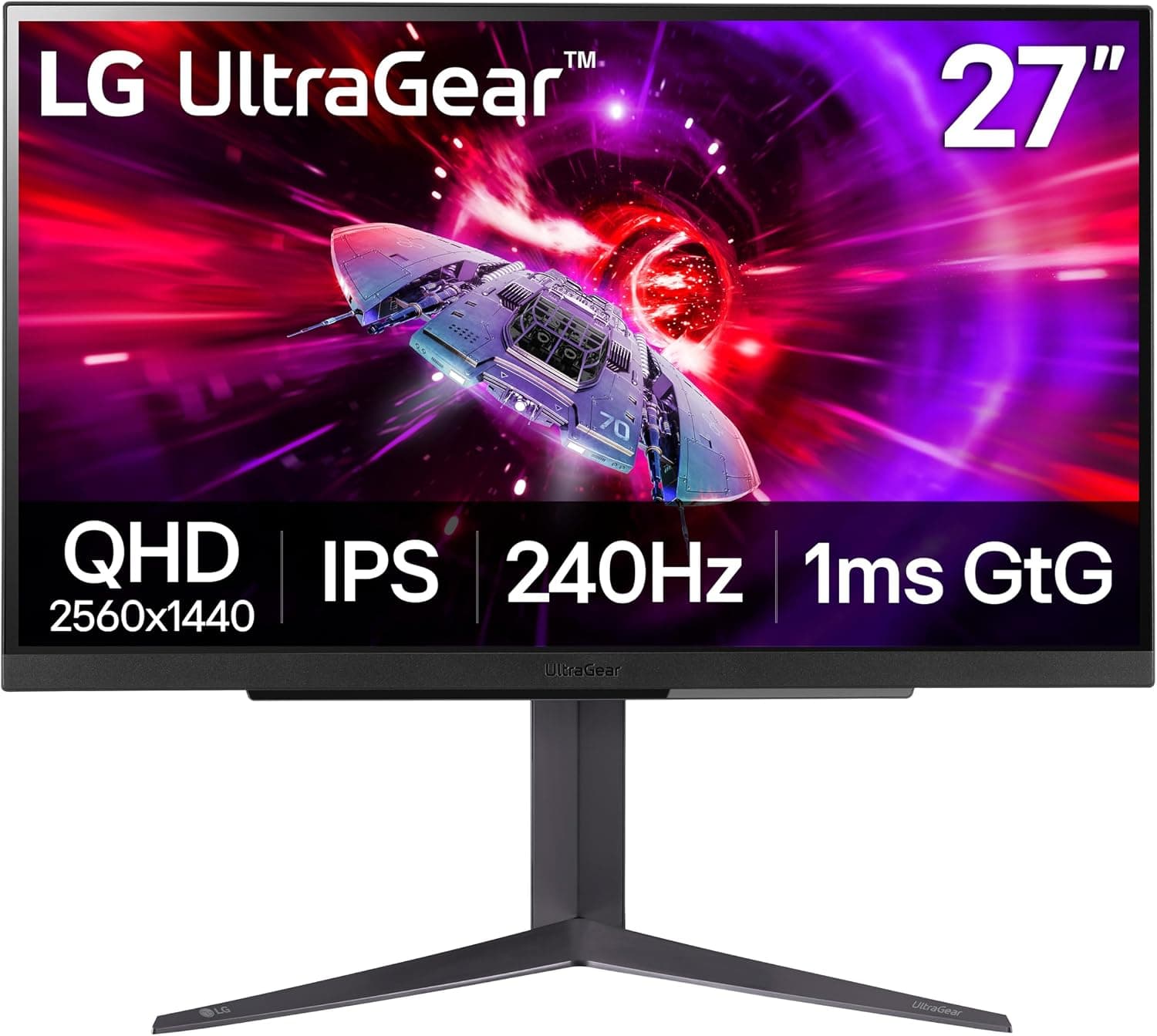
LG UltraGear 27GR83Q-B
LG's UltraGear 27GR83Q-B pairs a 27" 2560x1440 IPS panel with a 240Hz refresh rate and a rated 1ms GtG response, with official FreeSync Premium and G-Sync Compatible support. It adds two HDMI 2.1 inputs alongside DisplayPort 1.4, a 95% DCI-P3 color gamut and a stand that adjusts for height, tilt and pivot. Display Ninja and Monitornerds report input lag of about 3ms at 240Hz, while RTINGS notes low IPS contrast that makes blacks look gray in a dark room.
We may earn a commission when you buy through our links.
Our Verdict
Matches the Acer above it on core gaming specs (a 27" 1440p IPS at 240Hz with a rated 1ms GtG response) and adds a more complete feature set: two HDMI 2.1 inputs that carry 240Hz and VRR, official FreeSync Premium and G-Sync Compatible certification, a 95% DCI-P3 gamut and a height- and pivot-adjustable stand. Display Ninja and Monitornerds report input lag of about 3ms at 240Hz. It costs more than the Acer and LG lists no strobing mode to match Acer's 0.5ms VRB, which keeps it third; its 1440p panel is what puts it ahead of the 1080p Samsung and Dell.
Score Breakdown
Pros & Cons
Pros
- •27" 1440p IPS at 240Hz with about 3ms input lag reported by independent reviewers
- •Two HDMI 2.1 inputs that carry 240Hz and VRR, plus DisplayPort 1.4
- •Official FreeSync Premium and G-Sync Compatible certification
- •Wide 95% DCI-P3 color gamut
- •Height, tilt and pivot adjustable stand
Cons
- •Low (about 1,000:1) IPS contrast makes blacks look gray in a dark room
- •DisplayHDR 400 without local dimming adds little
- •The fastest overdrive setting overshoots, so 'Fast' is the usable mode
- •No swivel adjustment, and LG lists no backlight-strobing mode
Specifications
| Screen Size | 27" |
| Resolution | 2560x1440 |
| Refresh Rate | 240Hz |
| Panel | IPS |
| Response Time | 1ms GtG |
| Adaptive Sync | FreeSync Premium, G-Sync Compatible |
| Stand | Height / tilt / pivot |
| HDR | DisplayHDR 400 |
| Color Gamut | 95% DCI-P3 |
| Inputs | 2x HDMI 2.1, 1x DisplayPort 1.4 |
Quick Answers
What is the screen size of the LG UltraGear 27GR83Q-B?
LG UltraGear 27GR83Q-B screen size: 27".
What is the resolution of the LG UltraGear 27GR83Q-B?
LG UltraGear 27GR83Q-B resolution: 2560x1440.
What is the refresh rate of the LG UltraGear 27GR83Q-B?
LG UltraGear 27GR83Q-B refresh rate: 240Hz.
What is the panel of the LG UltraGear 27GR83Q-B?
LG UltraGear 27GR83Q-B panel: IPS.
What is the response time of the LG UltraGear 27GR83Q-B?
LG UltraGear 27GR83Q-B response time: 1ms GtG.
What is the adaptive sync of the LG UltraGear 27GR83Q-B?
LG UltraGear 27GR83Q-B adaptive sync: FreeSync Premium, G-Sync Compatible.
What is the stand of the LG UltraGear 27GR83Q-B?
LG UltraGear 27GR83Q-B stand: Height / tilt / pivot.
What is the HDR of the LG UltraGear 27GR83Q-B?
LG UltraGear 27GR83Q-B HDR: DisplayHDR 400.
Who is the LG UltraGear 27GR83Q-B for?
It suits competitive players who want 1440p sharpness at 240Hz, pC and console players who need HDMI 2.1 inputs, users who want a height- and pivot-adjustable stand. It is not the right pick for dark-room players who want deep blacks, hDR content viewers, buyers who want the lowest price for 1440p at 240Hz.
Is the LG UltraGear 27GR83Q-B worth buying?
LG's UltraGear 27GR83Q-B pairs a 27" 2560x1440 IPS panel with a 240Hz refresh rate and a rated 1ms GtG response, with official FreeSync Premium and G-Sync Compatible support. It adds two HDMI 2.1 inputs alongside DisplayPort 1.4, a 95% DCI-P3 color gamut and a stand that adjusts for height, tilt and pivot. Display Ninja and Monitornerds report input lag of about 3ms at 240Hz, while RTINGS notes low IPS contrast that makes blacks look gray in a dark room. It ranks #3 in our Top 5 Gaming Monitors for Competitive FPS Under $300. Matches the Acer above it on core gaming specs (a 27" 1440p IPS at 240Hz with a rated 1ms GtG response) and adds a more complete feature set: two HDMI 2.1 inputs that carry 240Hz and VRR, official FreeSync Premium and G-Sync Compatible certification, a 95% DCI-P3 gamut and a height- and pivot-adjustable stand. Display Ninja and Monitornerds report input lag of about 3ms at 240Hz. It costs more than the Acer and LG lists no strobing mode to match Acer's 0.5ms VRB, which keeps it third; its 1440p panel is what puts it ahead of the 1080p Samsung and Dell.
Who Is This For?
Best For
- Competitive players who want 1440p sharpness at 240Hz
- PC and console players who need HDMI 2.1 inputs
- Users who want a height- and pivot-adjustable stand
Not For
- Dark-room players who want deep blacks
- HDR content viewers
- Buyers who want the lowest price for 1440p at 240Hz
Where to Buy
Appears In
Compare Head-to-Head
Customer Reviews
Alternatives to Consider
ASUS ROG Strix XG259QNS
ASUS
A purpose-built esports display. The XG259QNS pushes a Fast IPS panel to 380Hz (overclocked) with a rated 0.3ms minimum response and ELMB Sync, which lets ASUS run backlight strobing and variable refresh at the same time, the closest thing to CRT-like motion clarity you can buy under $300.
Acer Nitro XV272U W2bmiiprx
Acer
The value sweet spot for competitive play. Acer pairs a 27" 1440p IPS panel with a 240Hz refresh ceiling and a 0.5ms VRB motion mode, giving you the sharper QHD image most shooters benefit from without giving up the high frame rates competitive gaming lives on, and it routinely sells well under $200.
GIGABYTE M27Q X
GIGABYTE
A do-it-all 1440p 240Hz panel with a work-and-play twist. GIGABYTE's M27Q X runs a 27" Super-Speed IPS at 240Hz with a 1ms MPRT response and 92% DCI-P3 color, then adds a built-in KVM and USB-C so a gaming PC and a work laptop can share the same screen, keyboard, and mouse.
Samsung Odyssey G4 (G40B)
Samsung
A compact 25" competitive monitor built around a 240Hz IPS panel with a 1ms GtG response, dual G-Sync Compatible and FreeSync Premium support, and a fully adjustable stand that most sub-$250 gaming monitors leave out. The smaller 25" size keeps 1080p pixel density reasonable and puts the whole picture inside your field of view.