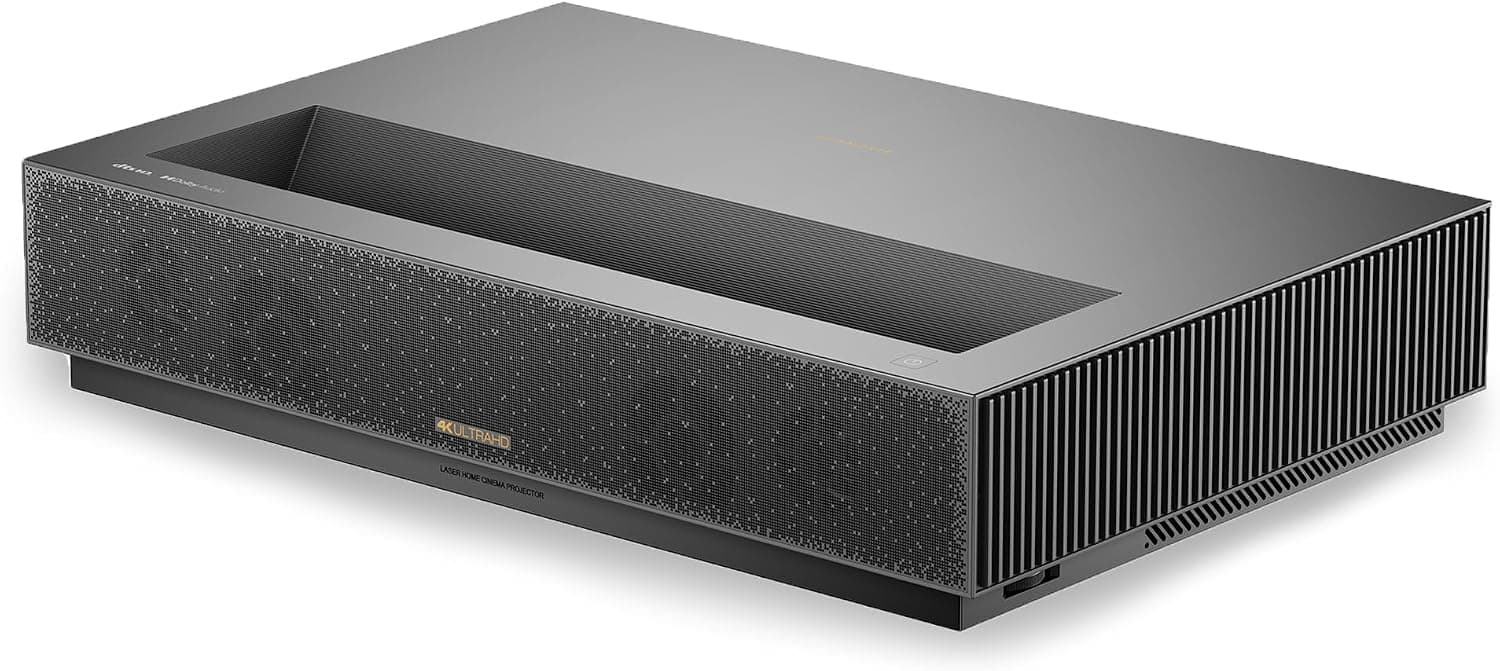
Formovie Cinema Edge
A compact, all-in-one 4K laser UST with Google TV and officially licensed Netflix, rated at 2,100 ISO lumens. The Smart Home Hookup named it its best UST under $2,000 in 2025, and TechRadar and Engadget both credit its sharp 4K image and tidy package. It ranks last here because it is the only pick without Dolby Vision (HDR10 and HLG only), Engadget measured about 40 ms of input lag at 60Hz, and reviewers found its color and Google TV processor underwhelming next to similarly priced rivals.
We may earn a commission when you buy through our links.
Our Verdict
The simplest setup here: like the Hisense PL2 it runs Google TV, and it adds officially licensed Netflix in a compact chassis rated at 2,100 ISO lumens. The Smart Home Hookup named it its best UST under $2,000 for 2025. It ranks last because it is the only pick without Dolby Vision or HDR10+, Engadget measured about 40 ms of input lag (vs 15 ms for the LTV-2500), and TechRadar and Engadget both found its color underwhelming. At about $1,799 it also costs $300 more than the better-equipped PL2.
Score Breakdown
Pros & Cons
Pros
- •Google TV with officially licensed Netflix built in: no stick, one remote
- •Sharp 4K image in a compact cabinet (TechRadar, Engadget); The Smart Home Hookup's best UST under $2,000 for 2025
- •Rated 2,100 ISO lumens with a 0.23:1 throw
Cons
- •No Dolby Vision or HDR10+ (HDR10 and HLG only), and color and gamut are underwhelming (TechRadar, Engadget)
- •About 40 ms input lag at 60Hz (Engadget) and a sluggish Google TV processor
Specifications
| Rated Brightness | 2,100 ISO lumens |
| Light Source | Blue laser + phosphor (ALPD) |
| Image Size | 80–150 in |
| Throw / 100" Distance | 0.23:1; about 19 in from the screen for 150 in |
| HDR Formats | HDR10, HLG |
| Input Lag | About 40 ms at 60Hz (Engadget); 60Hz max |
| Smart OS | Google TV (licensed Netflix) |
| Speakers | 2 x 15W, Dolby Audio / DTS-HD |
Quick Answers
What is the rated brightness of the Formovie Cinema Edge?
Formovie Cinema Edge rated brightness: 2,100 ISO lumens.
What is the light source of the Formovie Cinema Edge?
Formovie Cinema Edge light source: Blue laser + phosphor (ALPD).
What is the image size of the Formovie Cinema Edge?
Formovie Cinema Edge image size: 80–150 in.
What is the throw / 100" distance of the Formovie Cinema Edge?
Formovie Cinema Edge throw / 100" distance: 0.23:1; about 19 in from the screen for 150 in.
What is the hdr formats of the Formovie Cinema Edge?
Formovie Cinema Edge hdr formats: HDR10, HLG.
What is the input lag of the Formovie Cinema Edge?
Formovie Cinema Edge input lag: About 40 ms at 60Hz (Engadget); 60Hz max.
What is the smart os of the Formovie Cinema Edge?
Formovie Cinema Edge smart os: Google TV (licensed Netflix).
What is the speakers of the Formovie Cinema Edge?
Formovie Cinema Edge speakers: 2 x 15W, Dolby Audio / DTS-HD.
Who is the Formovie Cinema Edge for?
It suits buyers who want Netflix built in with no extra devices, smaller living rooms and compact media stands, casual TV and streaming viewing. It is not the right pick for hDR enthusiasts who want Dolby Vision, competitive or console gamers, viewers who prioritize color accuracy.
Is the Formovie Cinema Edge worth buying?
A compact, all-in-one 4K laser UST with Google TV and officially licensed Netflix, rated at 2,100 ISO lumens. The Smart Home Hookup named it its best UST under $2,000 in 2025, and TechRadar and Engadget both credit its sharp 4K image and tidy package. It ranks last here because it is the only pick without Dolby Vision (HDR10 and HLG only), Engadget measured about 40 ms of input lag at 60Hz, and reviewers found its color and Google TV processor underwhelming next to similarly priced rivals. It ranks #5 in our Top 5 Ultra Short Throw Projectors Under $2,000. The simplest setup here: like the Hisense PL2 it runs Google TV, and it adds officially licensed Netflix in a compact chassis rated at 2,100 ISO lumens. The Smart Home Hookup named it its best UST under $2,000 for 2025. It ranks last because it is the only pick without Dolby Vision or HDR10+, Engadget measured about 40 ms of input lag (vs 15 ms for the LTV-2500), and TechRadar and Engadget both found its color underwhelming. At about $1,799 it also costs $300 more than the better-equipped PL2.
Who Is This For?
Best For
- Buyers who want Netflix built in with no extra devices
- Smaller living rooms and compact media stands
- Casual TV and streaming viewing
Not For
- HDR enthusiasts who want Dolby Vision
- Competitive or console gamers
- Viewers who prioritize color accuracy
Where to Buy
Appears In
Compare Head-to-Head
Customer Reviews
Alternatives to Consider
Hisense PL2
Hisense
Hisense's second-generation entry UST and the strongest all-round package under $2,000: a 4K (0.47-inch DLP XPR) laser projector rated at 2,700 ANSI lumens, with Dolby Vision, a 0.22:1 lens that throws a 100-inch image from about 7 inches off the wall, and Google TV built in on the US model. What Hi-Fi called it the best UST it has reviewed on performance per dollar, praising its balanced, consistent picture and dark detail. Its single blue laser cannot match the color volume of the triple-laser AWOL models, and gaming tops out at 4K/60.
AWOL Vision LTV-3000 Pro
AWOL Vision
The brightest projector in this group by independent measurement and the best picture under $2,000 if you supply your own streaming device. Its RGB triple-laser engine (no color wheel) measured 2,586 ANSI lumens for Projector Reviews against a 2,400 rating, and that reviewer praised its well-tuned out-of-the-box color and excellent black levels. Dolby Vision and HDR10+, 15 ms input lag at 4K/60 and a 36W Dolby Atmos system round out the spec sheet. The weak point is software: the built-in launcher has no useful apps, so plan on a streaming stick.
NexiGo Aurora Lite
NexiGo
The gaming and dark-room specialist of the group. NexiGo's 4K UST uses an ALPD 4.0 hybrid tri-color laser with dynamic laser dimming, and The Smart Home Hookup measured a native contrast of 3,632:1 with a low black floor in its 2024 UST shootout. It is the only pick here that accepts a 4K/120Hz signal, with under 10 ms lag at 1080p/240Hz in that test, and its 60W four-driver Dolby Atmos system is the largest built-in sound in the list. The trade-off is brightness: rated at 1,900 ANSI lumens, it measured about 1,287 lumens once calibrated in an AVS Forum review.
AWOL Vision LTV-2500
AWOL Vision
The least expensive RGB triple-laser UST we found sold new on Amazon US, with the same Dolby Vision and HDR10+ support, 0.25:1 throw and 36W Dolby Atmos speakers as the pricier LTV-3000 Pro, and a Fire TV Stick 4K Max included per the current listing. It is the oldest design here (2022): ProjectorCentral measured 1,682 ISO lumens at maximum, well below the 3000 Pro, and noted a blue bias that benefits from calibration. Lag is the same 15 ms at 4K/60 and 8 ms at 1080p/120 as its sibling.