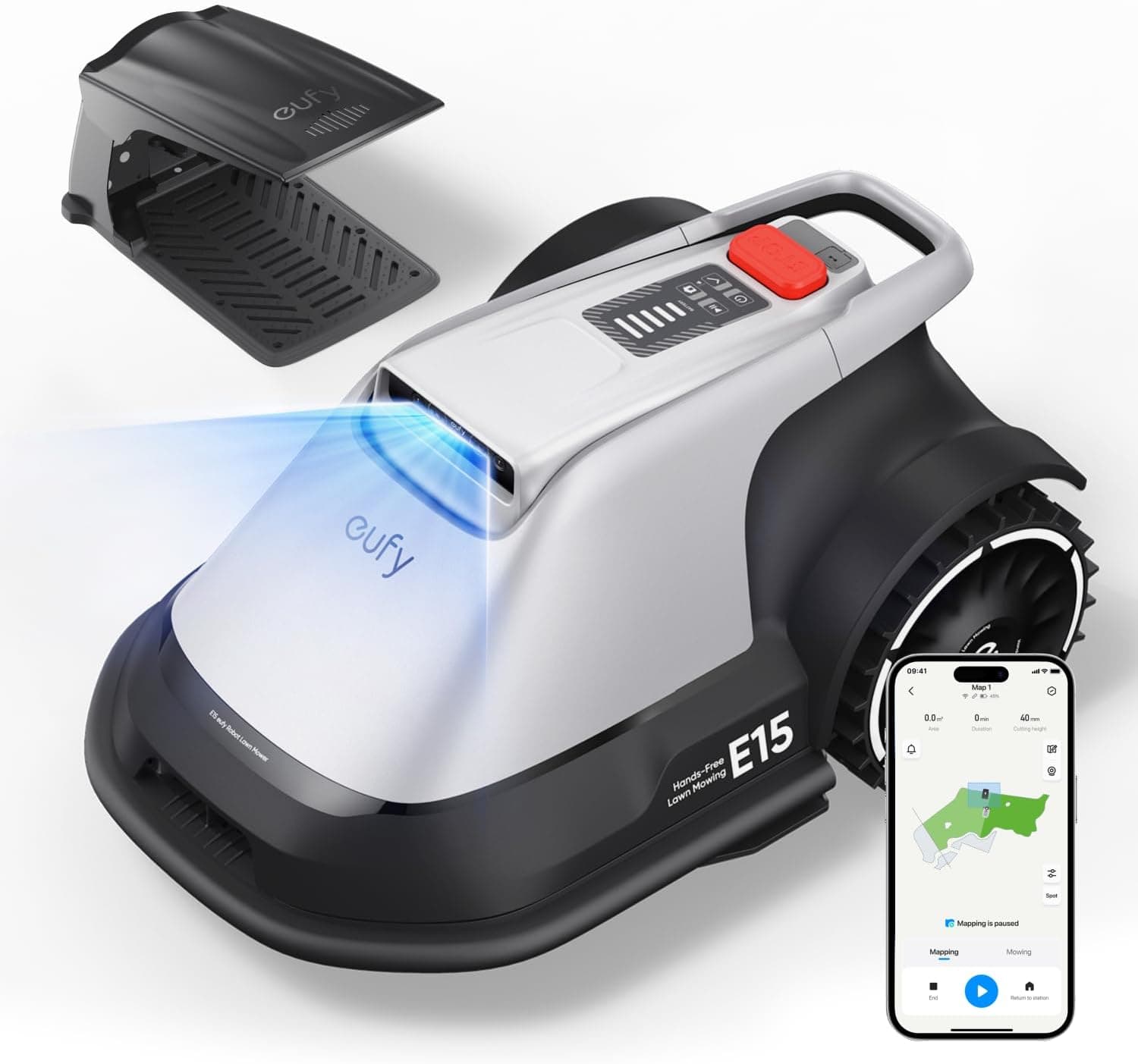
eufy Robot Lawn Mower E15
The most hands-off setup here, and the pick for buyers who want to skip both boundary wires and RTK antennas entirely. The E15 navigates by pure vision (eufy's V-FSD 1.0 uses stereo cameras and AI to see, map, and mow on its own) and layers on the extras that matter for a robot left outside unattended: built-in GPS anti-theft, automatic recall in rain or low light, and 3D obstacle avoidance. It costs more than the wire-free RTK models, but it's the closest thing to a set-and-forget robot for a simple small lawn.
We may earn a commission when you buy through our links.
Our Verdict
The most hands-off setup on the list: pure-vision navigation skips both the boundary wire and the RTK antenna, and it adds the extras that matter for a robot left outside: built-in GPS anti-theft, rain auto-recall, and 3D obstacle avoidance. It ranks second rather than first because it costs noticeably more than the Navimow and its camera-only navigation is the most likely here to get confused on a complex or irregular lawn.
Score Breakdown
Pros & Cons
Pros
- •Pure-vision navigation: no boundary wire and no RTK antenna to place
- •Built-in GPS anti-theft tracking as standard
- •Auto-recall to base in rain or low light
- •3D obstacle avoidance for rocks, toys, and pool borders
- •Clean parallel cutting lines with coverage re-checking
Cons
- •Camera-only navigation can lose its way on complex or irregular lawns
- •One of the pricier picks for a small-yard robot
- •Limited to gentle 18° slopes and grass under 3.5 inches
Specifications
| Coverage Area | Up to 0.2 acre (~8,700 sq ft) |
| Navigation | Pure Vision (V-FSD 1.0), wire-free |
| Perimeter Wire | Not required |
| Max Slope | 18° |
| Cutting Width | 8 in |
| Cutting Height | 1–3 in |
| Noise Level | <56 dB |
| Anti-Theft | Built-in GPS tracking |
Quick Answers
What is the coverage area of the eufy Robot Lawn Mower E15?
eufy Robot Lawn Mower E15 coverage area: Up to 0.2 acre (~8,700 sq ft).
What is the navigation of the eufy Robot Lawn Mower E15?
eufy Robot Lawn Mower E15 navigation: Pure Vision (V-FSD 1.0), wire-free.
What is the perimeter wire of the eufy Robot Lawn Mower E15?
eufy Robot Lawn Mower E15 perimeter wire: Not required.
What is the max slope of the eufy Robot Lawn Mower E15?
eufy Robot Lawn Mower E15 max slope: 18°.
What is the cutting width of the eufy Robot Lawn Mower E15?
eufy Robot Lawn Mower E15 cutting width: 8 in.
What is the cutting height of the eufy Robot Lawn Mower E15?
eufy Robot Lawn Mower E15 cutting height: 1–3 in.
What is the noise level of the eufy Robot Lawn Mower E15?
eufy Robot Lawn Mower E15 noise level: <56 dB.
What is the anti-theft of the eufy Robot Lawn Mower E15?
eufy Robot Lawn Mower E15 anti-theft: Built-in GPS tracking.
Who is the eufy Robot Lawn Mower E15 for?
It suits simple, open small lawns that want zero-install setup, buyers who want built-in anti-theft and rain auto-recall, households that will manage zones and scheduling from the app. It is not the right pick for complex, fragmented, or heavily obstacle-filled yards, slopes steeper than 18°.
Is the eufy Robot Lawn Mower E15 worth buying?
The most hands-off setup here, and the pick for buyers who want to skip both boundary wires and RTK antennas entirely. The E15 navigates by pure vision (eufy's V-FSD 1.0 uses stereo cameras and AI to see, map, and mow on its own) and layers on the extras that matter for a robot left outside unattended: built-in GPS anti-theft, automatic recall in rain or low light, and 3D obstacle avoidance. It costs more than the wire-free RTK models, but it's the closest thing to a set-and-forget robot for a simple small lawn. It ranks #2 in our Top 5 Robot Lawn Mowers for Small Yards. The most hands-off setup on the list: pure-vision navigation skips both the boundary wire and the RTK antenna, and it adds the extras that matter for a robot left outside: built-in GPS anti-theft, rain auto-recall, and 3D obstacle avoidance. It ranks second rather than first because it costs noticeably more than the Navimow and its camera-only navigation is the most likely here to get confused on a complex or irregular lawn.
Who Is This For?
Best For
- Simple, open small lawns that want zero-install setup
- Buyers who want built-in anti-theft and rain auto-recall
- Households that will manage zones and scheduling from the app
Not For
- Complex, fragmented, or heavily obstacle-filled yards
- Slopes steeper than 18°
Where to Buy
Appears In
Compare Head-to-Head
Customer Reviews
Alternatives to Consider
Segway Navimow i105N
Segway
The best all-around robot mower for a small yard, and the easiest to justify at its price. The Navimow i105N combines RTK positioning with a 140-degree VisionFence camera for wire-free setup (you walk the boundary once with your phone instead of burying a cable), and its AI can recognize 150-plus types of common garden obstacles. For a compact lawn up to about a quarter of what its bigger siblings cover, it delivers the modern wire-free experience without the flagship price.
Gardena SILENO City
Gardena
The value pick and the quietest robot on this list. The SILENO City is a boundary-wire mower (you lay a perimeter cable once during setup), but in exchange you get German build quality, a class-leading 57 dB(A) noise level, and patented streak-free navigation that handles narrow passages and tight city-garden corners reliably. It's the least expensive mower here and the one to buy if you don't mind an afternoon of wire installation to save money and get a proven, low-drama cut.
Mammotion LUBA Mini AWD 800
Mammotion
The premium pick, and the one to buy only if your small yard has real slopes or rough terrain. The LUBA Mini AWD 800 is an all-wheel-drive robot that climbs gradients up to 80% (far beyond what any other mower here attempts), using RTK plus Mammotion's UltraSense AI Vision for wire-free positioning even under trees. It also carries the most complete feature set: 20-zone management, 4G/Bluetooth/Wi-Fi connectivity, and built-in GPS anti-theft. For a flat, simple small lawn it's overkill; for a compact but hilly or uneven one, nothing else on this list keeps up.
Mammotion LUBA mini 2 AWD 1500H
Mammotion
The premium pick, and the one to buy only if your small yard has real slopes, rough ground, or heavy tree cover. The LUBA mini 2 AWD 1500H is Mammotion's current successor to the LUBA mini AWD: an all-wheel-drive robot rated for 80% (38.6°) slopes inside the mowing area that navigates by 360-degree LiDAR plus dual-camera AI vision, so it needs neither a perimeter wire nor an RTK antenna. A dedicated edge disc trims to about 2.1 inches from walls, and built-in 4G GPS tracking, 20-zone mapping, and a 3-year warranty round out the most complete feature set here. It is rated for up to 0.37 acre, more than most small lawns need, so on a flat, simple yard its premium is hard to justify.