Lion's Mane for Focus and Memory ranked on form, dose, third-party testing and value per unit of active ingredient.
Updated August 5, 20265 rankedNo paid placements
We may earn a commission when you buy through our links. Prices and availability shown are accurate as of Aug 5, 2026 and are subject to change; the merchant's price at purchase applies.
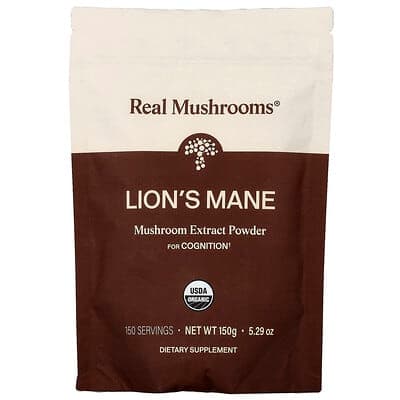
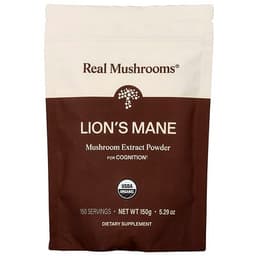
It ranks first because it combines the strongest beta-glucan disclosure, fruiting-body/no-grain composition and third-party marker verification. Those heavier-weighted attributes outweigh its price and more modest 742-review, 100-plus-sale footprint.
Quantifies 300 mg of beta-(1,3)(1,6)-glucans per 1 g servingLabel specifies mushroom extract with no grain, starch or fillersUSDA Organic and certified organic by Quality Assurance InternationalNo USP, NSF or publicly linked lot-specific product certificate of analysis was foundPowder format requires measuring and has the highest upfront price in this comparison
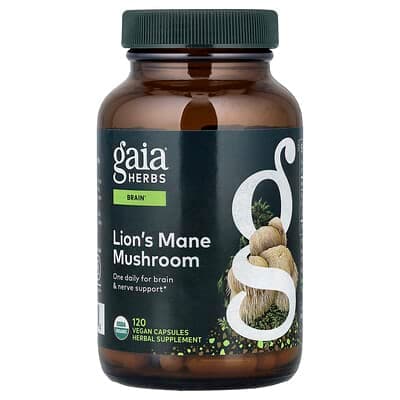
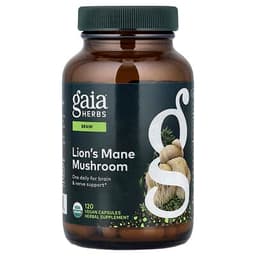
It ranks second because quantified beta-glucans, fruiting-body-only extract and unusually clean labeling outweigh its poor value. Its testing is well described but remains in-house, keeping it below Real Mushrooms.
Quantifies 83 mg of beta-glucans per capsuleFruiting-body extract contains no mycelium, growing medium or internal fillerUSDA Organic, Oregon Tilth certified and Non-GMO Project VerifiedCosts approximately $6.19 per gram of labeled beta-glucansHeavy-metal testing is performed in Gaia's own ISO-certified laboratory rather than under a recognized independent product certification
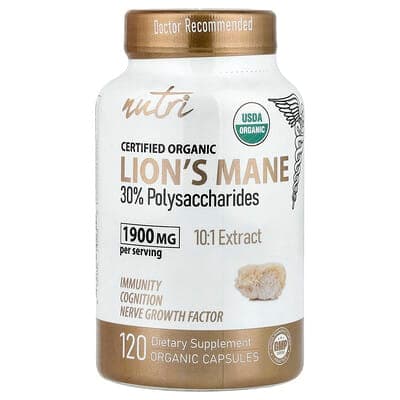
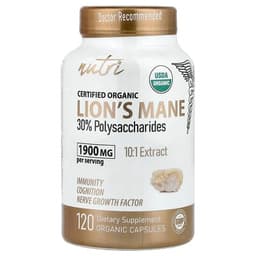
The 10:1 fruiting-body extract and price place it ahead of unstandardized lower-dose products, but the nonspecific polysaccharide claim keeps it below both beta-glucan-quantified picks. Its newer 162-review history and 300-plus 30-day sales are secondary to those composition differences.
Label specifies a 10:1 fruiting-body extractProvides 1,900 mg of actual extract per servingUSDA Organic and certified organic by CCOFDeclares total polysaccharides rather than mushroom-specific beta-glucansThe label claims third-party laboratory verification, but no product-specific COA is linked
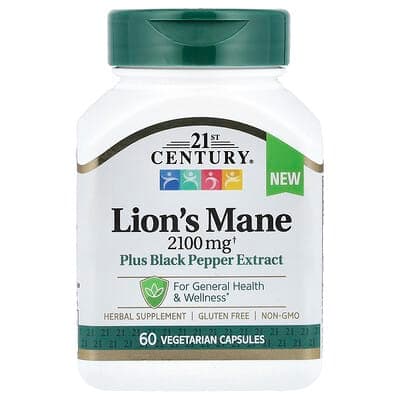
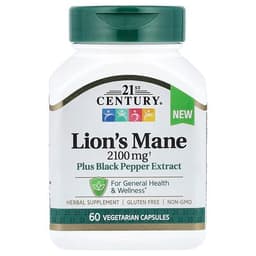
Its disclosed 4:1 fruiting-body extraction, dose equivalence and value place it above NOW despite a much smaller review history. Missing beta-glucan measurement, organic certification and independent testing evidence prevent a higher rank.
Clearly distinguishes 525 mg of actual 4:1 extract from the 2,100 mg dry equivalentUses Lion's Mane fruiting body rather than mycelium-on-grainCosts $0.21 per one-capsule servingNo organic certification or quantified beta-glucan contentContains magnesium silicate, magnesium stearate and silicon dioxide, plus 10 mg of black-pepper extract not used in the cited Lion's Mane trials
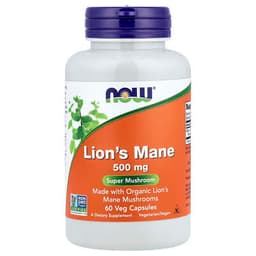
Its organic fruiting-body form and 2,400-plus reviews establish buyer trust, but popularity cannot offset the undisclosed beta-glucan content, extraction ratio and product-specific testing results. Those heavier-weighted gaps place it fifth.
Label specifies organic Lion's Mane fruiting-body extractCertified organic by QAI and Non-GMO Project VerifiedFully discloses a 1,000 mg two-capsule serving without a proprietary blendNo extract ratio or quantified beta-glucan amountOnly 30 servings, at $0.53 each, with organic inulin added
21st Century, Lion's Mane, 2,100 mg, 60 Veg Capsules
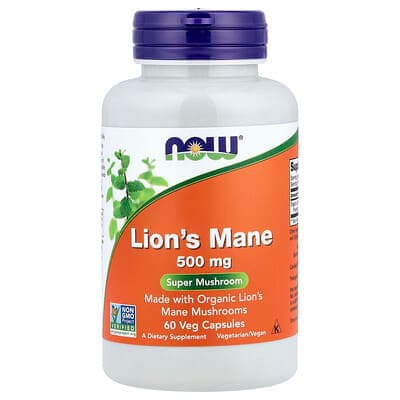
NOW Foods, Lion's Mane, 500 mg, 60 Veg Capsules
Brand
Real Mushrooms
Gaia Herbs
Nutri
21st Century
NOW Foods
Mushroom material
Organic mushroom fruiting body; no grain, starch or fillers
Organic Lion's Mane fruiting body extracts; no mycelium or growing medium
Organic Lion's Mane fruiting body
Lion's Mane fruiting body
Organic Lion's Mane fruiting body
Extract type
Mushroom extract; ratio and dual-extraction status not stated on the iHerb label
Fruiting-body extracts; 450 mg is labeled equivalent to 2.5 g dry mushrooms; dual extraction not stated
10:1 extract; dual-extraction method not stated
525 mg of 4:1 extract, equivalent to 2,100 mg dried mushroom; dual extraction not stated
Extract powder; ratio and dual-extraction status not stated
Labeled dose
1,000 mg extract per 1 g serving
450 mg extract per capsule
1,900 mg extract per 3-capsule serving
525 mg actual extract plus 10 mg BioPerine per capsule
1,000 mg per 2-capsule serving
Beta-glucans
300 mg beta-(1,3)(1,6)-glucans per serving
83 mg per serving
Not quantified; label states 30% total polysaccharides
Not quantified; label only says naturally occurring polysaccharides
Not quantified
Organic certification
USDA Organic; certified organic by QAI
USDA Organic; certified organic by Oregon Tilth
USDA Organic; certified organic by CCOF
None stated
Certified organic by QAI
Testing and heavy metals
Brand reports third-party beta-glucan verification and testing for heavy metals, agricultural chemicals and microbes; no lot-specific COA is linked by iHerb
Gaia reports in-house ISO-certified ICP-MS testing for arsenic, mercury, cadmium and lead, plus lot traceability through Meet Your Herbs; not independent product certification
iHerb label says third-party lab tested and GMP certified; no product-specific heavy-metal results or COA are linked
Label says Guaranteed Quality Laboratory Tested; no recognized external certification, heavy-metal result or product-specific COA is linked
Packaged and quality tested in the USA with Intertek GMP facility certification; no public product-specific COA or heavy-metal result is linked
Other ingredients
None listed
Organic pullulan vegan capsule
Organic pullulan capsule and organic rice extract blend containing rice bran extract, rice hulls, gum arabic and sunflower oil
Cellulose, magnesium silicate, magnesium stearate and silicon dioxide
Vegetable-polysaccharide capsule and organic inulin powder
Active-value basis
$1.55 per gram of labeled beta-glucans
$6.19 per gram of labeled beta-glucans
$0.77 per gram of claimed total polysaccharides; beta-glucan cost cannot be calculated
$0.40 per gram of actual 4:1 extract; beta-glucan cost cannot be calculated
$0.53 per gram of extract; beta-glucan cost cannot be calculated
Start with the mushroom material, not the front-label dose. A product labeled 100% fruiting body is materially different from mycelium grown on rice, oats or another grain. Mycelium is legitimate fungal tissue, but commercial mycelium-on-grain powders are normally harvested with residual growing substrate, so part of the labeled weight can be grain starch. For this comparison, explicit fruiting-body-only products outrank full-spectrum, mycelial-biomass and fermented-grain formulas. Next, look for beta-(1,3)(1,6)-glucans in milligrams or as a percentage. This is more informative than total polysaccharides. Beta-glucans are polysaccharides, but grain-derived alpha-glucans and ordinary starch are also polysaccharides. Consequently, a 30% polysaccharides claim cannot be interpreted as 30% beta-glucans. A strong label quantifies beta-glucans and ideally supplies alpha-glucan or starch results as an adulteration check. This distinction helps prevent buyers from paying for an impressive gram figure that may include growing substrate or other carbohydrates. Extraction and dose require normalization. Mushroom cell walls contain chitin; water extraction is commonly used for water-soluble beta-glucans, while dual water-and-ethanol extraction can also capture less water-soluble constituents. Dual extraction is not automatically superior: the actual extract mass, ratio, marker compounds and analytical results still matter. A label stating 525 mg of 4:1 extract, equivalent to 2,100 mg dried mushroom, contains 525 mg of extract, not 2,100 mg of powder. Do not compare dry-equivalent figures directly with actual extract weight. There is no established consumer dose proven to improve focus or memory. Controlled human studies have used different populations and materials. Mori and colleagues used three daily doses totaling 3 g of tablets containing 96% fruiting-body powder, or approximately 2.88 g of mushroom powder, for 16 weeks. Another trial used 3.2 g daily of powdered fruiting body for 12 weeks. A healthy-adult pilot used 1.8 g daily of a mixed mycelium-and-fruiting-body complex for 28 days. A newer acute study used 3 g of a 10:1 fruiting-body extract and did not find a significant overall cognitive effect. Extracts with different ratios are not automatically equivalent to these interventions, and trial findings have not been consistent across cognitive outcomes. Read certifications narrowly. USDA Organic, CCOF, Oregon Tilth and QAI certification address agricultural and processing standards; they do not establish beta-glucan potency or prove that a particular lot passed heavy-metal limits. Recognized independent certification or a product-specific, lot-dated certificate of analysis is stronger evidence. A useful mushroom COA should cover species identity, beta- and alpha-glucans, lead, cadmium, arsenic, mercury, pesticides and microbes. An ISO-certified in-house laboratory is useful but is not independent, while a generic lab-tested statement without results deserves a low testing score. Finally, calculate value per gram of measured beta-glucans, not per bottle or capsule. Where beta-glucans are undisclosed, cost per gram of extract is only a fallback and carries more uncertainty. Common mistakes include treating organic certification as contaminant proof, assuming the highest extract ratio must be best, comparing equivalent mushroom weight with actual extract weight, or letting review volume override composition and testing transparency. One last thing worth knowing before you shop: the best-selling lion's mane on iHerb at the time of writing is not on this list, and the reason is its label. California Gold Nutrition's Organic Lion's Mane carries thousands of reviews and a 4.7-star average, but its supplement facts panel declares "mycelium, primordia, fruiting bodies, and extracellular compounds" at 600 mg per capsule. In other words, it's a full-spectrum myceliated biomass grown on a substrate, where "extracellular compounds" refers to material from the growing medium rather than the mushroom itself. It states no extract ratio and no beta-glucan or polysaccharide figure, so there is no way to tell from the label how much active mushroom compound a capsule delivers. Popular fruiting-body options such as Swanson's Full Spectrum and Force Factor's capsules are a step up in that they specify fruiting body, but they too are plain 500 mg powders with no concentration or beta-glucan figure. That is the whole hierarchy in one sentence: a quantified beta-glucan extract beats an unquantified fruiting-body extract, which beats a plain fruiting-body powder, which beats myceliated biomass, and review count tells you nothing about where a product sits on it.
We rank on third-party testing (30%), form and bioavailability (25%), dose versus published human research (20%), label transparency (15%) and value per unit of active ingredient (10%). Specifications are taken from each product's supplement facts panel on its iHerb listing, and certification claims are checked against the certifying body's directory where one is published. We do not test products ourselves, and nothing here is medical advice.
Third-Party Testing
Independent certification or a published certificate of analysis
30%
Form & Bioavailability
Whether the chemical form is the well-absorbed one
25%
Dose vs Research
Per-serving dose versus doses used in published human trials
20%
Label Transparency
Full per-ingredient disclosure and minimal fillers
Why is quantified beta-glucan content more useful than a polysaccharide percentage?
Beta-glucans are specific fungal polysaccharides that laboratories can quantify. Total polysaccharides can also include alpha-glucans and grain starch, so a high polysaccharide percentage does not prove a high mushroom beta-glucan concentration. Prefer a label reporting beta-(1,3)(1,6)-glucans and, ideally, a supporting product or lot-specific analysis.
Is fruiting body absorbed better than mycelium?
Fruiting body and mycelium contain different constituent profiles, so the distinction is not simply that one is always absorbed better. The practical purchasing problem is mycelium-on-grain: residual rice or oats can contribute substantial starch to the finished powder. For a fruiting-body comparison, choose a product that identifies the mushroom part, excludes grain substrate and states its extraction method or marker content.
What Lion's Mane dose matches published human research?
There is no established dose proven for focus or memory. Trials have used approximately 2.88-3.2 g daily of fruiting-body powder for 12-16 weeks, 1.8 g daily of a mixed mycelium-and-fruiting-body complex for 28 days, and 3 g of a 10:1 fruiting-body extract in an acute study. These preparations are not interchangeable, and the acute 10:1 study did not find a significant overall cognitive effect.
What testing evidence should a buyer seek for Lion's Mane?
The strongest evidence is recognized independent certification or a recent, lot-matched third-party certificate of analysis. It should identify the species and report beta-glucans, alpha-glucans or starch, lead, cadmium, arsenic, mercury, pesticides and microbial results. Organic certification and GMP certification are useful but do not substitute for product-specific potency and contaminant results.