The best short-throw projectors for home golf simulators, scored on impact-screen brightness, input lag, throw-distance fit for 10-14 ft bays, and long-term reliability.
Updated July 18, 20265 rankedNo paid placements
We may earn a commission when you buy through our links.
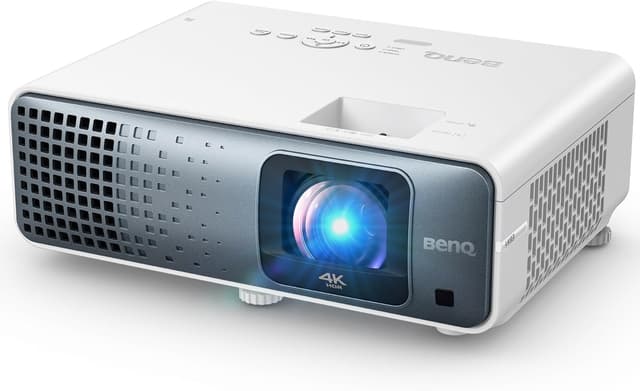
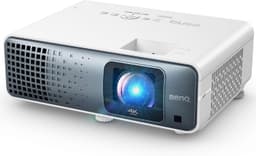
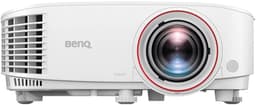
The best all-around golf-sim projector you can actually buy on Amazon: true 4K resolution makes course textures visibly sharper on a 10-foot impact screen than any 1080p rival, input lag is the lowest here at 1080p (4.2 ms at 240Hz), and its 1.2x optical zoom is the only real mounting flexibility in the group. It edges the brighter Optoma GT2400HDR because resolution and placement flexibility matter for the life of the build, while its brightness deficit (about 2,478 ANSI measured by ProjectorCentral) is solvable with basic light control.
True 4K UHD resolution resolves course textures, grain on greens, and distant fairways far more sharply than the 1080p alternatives1.2x optical zoom plus 0.69-0.83:1 throw ratio gives real mounting flexibility: the only projector here that lets you fine-tune image size without moving the mountVery low input lag (4.2 ms at 1080p/240Hz, 16.7 ms at 4K/60Hz) for lag-free simulator responseProjectorCentral's measurements put real output around 2,478 ANSI lumens in the brightest mode, about 23% below the 3,200 rating, and practical calibrated modes are dimmer stillAt around $1,899 it costs roughly $700 more than the brighter (though 1080p) Optoma GT2400HDR
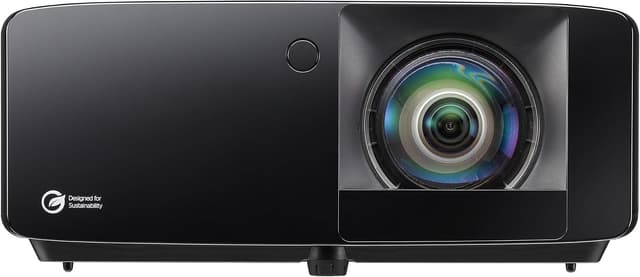
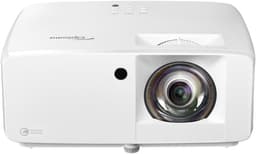
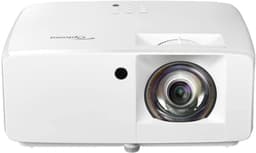
Nearly all of the practical golf-sim performance for $700 less than the BenQ: it's the brightest projector here at 4,200 rated lumens, has the group's lowest input lag at 8.4 ms, adds a dedicated golf sim picture mode, and its IP6X-sealed 30,000-hour laser is built for dusty garage bays. It beats the older GT2100HDR on the golf mode, marginally lower lag, and first-party Amazon stock; only the TK710STi's 4K image and zoom flexibility keep it from the top spot.
Brightest pick here at 4,200 rated lumens: the safest choice for garages and rooms with ambient light hitting the impact screenLowest input lag of the group at 8.4 ms (1080p/120Hz), with a dedicated golf sim picture mode tuned for grass and sky tones0.496:1 throw fills a 100-inch image from about 3.6 ft, fitting even very shallow bays with the projector safely out of swing range1080p resolution, so course detail is visibly softer than the BenQ TK710STi's 4K image on a large screenFixed lens with no optical zoom means mounting position must be calculated exactly; all image-size adjustment is physical
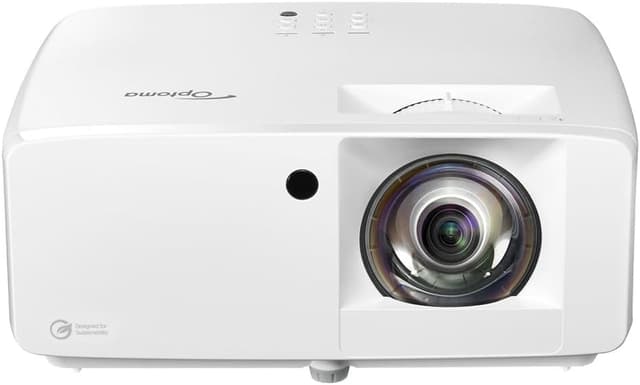
The proven mid-tier pick: Golfstead's 2026 guide ranks it the #1 golf simulator projector, and it delivers the same 4,200-lumen laser, 0.496:1 throw, and IP6X dust sealing as the GT2400HDR for less money. It sits below its successor only because the GT2400HDR adds a golf-specific picture mode and Amazon first-party availability for a modest premium, and it clearly beats the GT2000HDR below it on the 20% brightness advantage that matters most on an impact screen.
Same 4,200-lumen laser output and 0.496:1 throw as the newer GT2400HDR, usually at a lower priceProven pick with an established track record in the golf-sim community: Golfstead's 2026 guide ranks it #1 overall8.6 ms input lag (1080p/120Hz) keeps GSPro and E6 ball flight feeling instantaneousAmazon stock comes from third-party sellers rather than Amazon or Optoma directly, so price and availability fluctuateNo golf-specific picture mode; the GT2400HDR adds that tuning for roughly $170 more
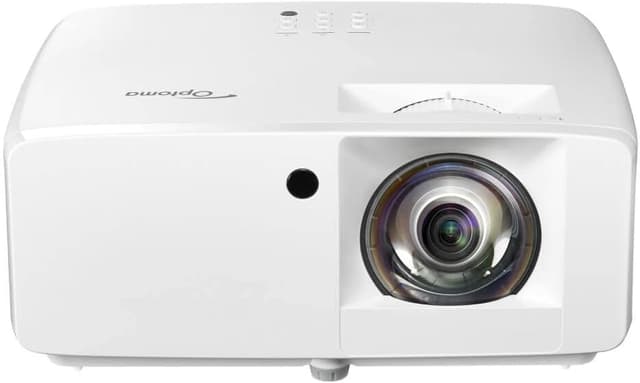
The budget pick that keeps the specs that actually matter: a 30,000-hour laser, IP6X dust sealing, the same 0.496:1 short throw, and 8.6 ms gaming input lag, at the lowest price of any laser here. It ranks above the TH671ST because it's brighter (3,500 vs 3,000 lumens), faster, cheaper, and maintenance-free, but below the GT2100HDR because its 20% lower output needs a light-controlled room to look its best.
Lowest price of any laser option here while keeping the 0.496:1 short throw, 30,000-hour light source, and IP6X dust sealing3,500 lumens is still bright enough for a light-controlled bay and beats every lamp projector in this class8.6 ms input lag (1080p/120Hz enhanced gaming mode) matches the pricier GT2100HDRAbout 20% dimmer than the GT2100HDR/GT2400HDR, so in a garage with ambient light the image washes out soonerAmazon stock often comes from smaller third-party sellers with limited quantities
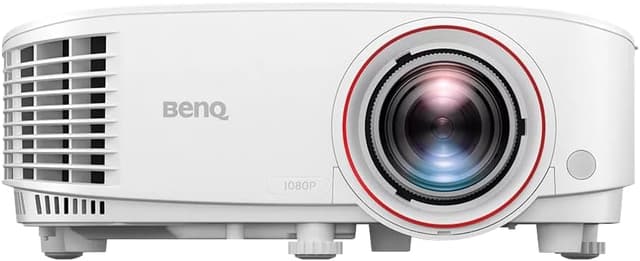
The most proven projector in home golf simulation: sim specialists from Carl's Place to Rapsodo have packaged it for years, and its 1.2x zoom makes placement more forgiving than any fixed-lens Optoma. It ranks last in 2026 on hardware economics alone: its lamp dims with age and lacks dust sealing, and at its current Amazon price it costs more than the brighter, laser-based GT2000HDR. Choose it for the track record and zoom flexibility, not the spec sheet.
The most proven projector in home golf simulation, with years of owner installs and setup guides from Carl's Place, Rapsodo, and other sim specialists1.2x optical zoom and auto vertical keystone make placement more forgiving than any fixed-lens Optoma16.7 ms input lag and a dedicated low-latency game mode keep simulator response crispLamp light source dims over time and eventually needs replacement (rated 4,000 hours in normal mode, up to 15,000 in LampSave); every laser pick here is rated 20,000-30,000 hoursAt around $949 on Amazon it currently costs more than the brighter, laser-based Optoma GT2000HDR
A golf simulator asks more of a projector than any home theater does, and the spec priorities are almost inverted. Start with throw ratio, because it decides whether a projector physically fits your bay at all. The math is simple: throw distance = throw ratio × image width. Most home sim bays are 10-14 feet deep with an impact screen 9-12 feet wide, and the projector must sit above or behind the golfer: never between golfer and screen, where it would project their shadow onto the ball flight. A 0.496:1 lens like the Optoma GT-series fills a 10-foot-wide screen from just under 5 feet; a 0.69-0.83:1 lens like the BenQs needs 7-8 feet. Run that calculation against your room before anything else, and note that fixed-lens models (all three Optomas here) must be mounted at exactly the computed distance, while the BenQs' 1.2x optical zoom gives you a foot or two of forgiveness. Second, buy more brightness than home-theater guides suggest. Impact screens are thick, light-eating polyester (they scatter and absorb far more light than a proper projection screen), and most bays live in garages or basements with ambient light. Treat 3,000 lumens as the floor and 4,000+ as the target for a garage; be aware that rated lumens usually exceed measured output, sometimes by 20% or more, which is why we cite independent measurements where they exist. Third, input lag: simulator software like GSPro and E6 Connect feels responsive only when the projector adds minimal delay, so enable the game or golf mode and look for published figures under 20 ms. Every pick on this list qualifies, ranging from 4.2 ms to 16.7 ms. Fourth, weigh 4K against brightness at your budget: 4K resolves genuinely sharper course detail on a big screen, but it costs more, demands a stronger gaming PC, and in this price range trades away lumens: a bright 1080p laser is the more practical buy for most garage bays. Finally, think about the environment: sim bays are dusty places, with turf infill and ball debris in the air. A sealed, IP6X-rated laser engine rated for 20,000-30,000 hours will hold its brightness for the life of the build, while an open-chassis lamp model dims gradually and needs bulb replacements. Ceiling mounting just behind the hitting area is the standard install; make sure whatever you buy has keystone range or lens geometry that squares the image from that position.
Rankings score each projector on published manufacturer specifications, independent measurements and reviews (including ProjectorCentral's lab measurements and guides from The Hook Up, Golfstead, and Home Performance Lab), golf-simulator specialty retailer guidance (Carl's Place, The Indoor Golf Shop, Top Shelf Golf), and verified Amazon listing data for pricing and availability. TopsFive does not perform its own product testing; measured brightness figures cited come from the third-party sources named. This list deliberately covers only models purchasable on Amazon: BenQ's golf-branded AK700ST and AH500ST are strong options but sell mainly through specialty golf retailers. Because impact screens absorb light and sim bays often have ambient light, we weight brightness, input lag, and throw-distance fit more heavily than home-theater criteria like contrast in a dark room.
Image Brightness & Quality
Lumens on an impact screen, resolution, and color
30%
Input Lag
Delay between simulator output and on-screen ball flight
20%
Throw & Mounting Flexibility
Throw ratio fit for 10-14 ft bays, zoom, and placement forgiveness
20%
Reliability & Maintenance
Light source life and dust protection in garage bays
How many lumens do I need for a golf simulator projector?
More than for a home theater. Impact screens are made of thick, light-absorbing polyester weave, and most sim bays (garages especially) aren't fully dark. Treat 3,000 lumens as the working floor and 4,000+ as the comfortable target for a garage: the Optoma GT2400HDR and GT2100HDR lead this group at 4,200 rated lumens, the GT2000HDR's 3,500 works well with decent light control, and the BenQ TK710STi's measured ~2,478 ANSI (per ProjectorCentral) wants a light-controlled room to look its best.
What throw ratio do I need for a 10-14 ft deep golf sim bay?
Throw distance = throw ratio × image width. A 0.496:1 lens (all three Optomas here) fills a typical 10-ft-wide impact screen from just under 5 ft, so the projector mounts comfortably behind or above the golfer even in a 10-ft-deep bay. A 0.69-0.83:1 lens (both BenQs) needs roughly 7-8 ft for the same screen, which fits most 12-14 ft bays but gets tight in anything shallower. Standard-throw home theater projectors (1.5:1) don't fit sim bays at all: they'd need 15+ ft and would project the golfer's shadow onto the screen.
Does input lag actually matter for GSPro or E6 Connect?
Yes, though every projector on this list is fast enough. Simulator software renders ball flight a beat after launch-monitor data arrives, so a projector adding 50-100 ms (common in home-theater picture modes) makes the whole system feel mushy. All five picks here measure between 4.2 ms (BenQ TK710STi at 1080p/240Hz) and 16.7 ms (BenQ TH671ST) in their gaming modes, below the threshold most players can perceive. Just remember to enable the game/fast mode; the default cinema modes add lag on any projector.
Is a 4K projector worth it for a golf simulator?
It depends on your PC and priorities. On a 10-12 ft impact screen viewed from 10-12 ft away, the BenQ TK710STi's 4K image is noticeably sharper: course textures, distant flags, and UI text all resolve better. But driving GSPro at 4K needs a much stronger graphics card than 1080p, and the 1080p Optomas buy you 1,000+ extra rated lumens for less money. If your GPU is midrange or your bay has ambient light, a bright 1080p model is the more practical choice.
Can I use a regular home theater projector for a golf simulator?
Usually not. Standard-throw projectors need too much distance (a 1.5:1 lens wants over 15 ft for a 10-ft-wide image), which puts the golfer between the projector and screen, casting a shadow exactly where the ball flight renders. Short-throw models like these mount above or just behind the hitting area, out of the swing path and shadow zone. Golf bays also punish lamps and open chassis with dust from turf and ball impacts, which is why the laser Optomas' IP6X-sealed engines are a genuine advantage.