Snapmaker U1 vs Bambu Lab A1 Combo
Snapmaker U1 (#3) vs Bambu Lab A1 Combo (#5, best budget): in our Multi-Color 3D Printers Under $1,000 scoring the Snapmaker U1 totals 8.3/10 and the Bambu Lab A1 Combo 7.5/10.
We may earn a commission when you buy through our links.
TopsFive comparison scores
Side by side
| Snapmaker U1 | Bambu Lab A1 Combo | |
|---|---|---|
| Multi-Color System | SnapSwap toolchanger (4 independent toolheads) | AMS lite (single-nozzle filament swapping) |
| Max Colors | 4 | 4 |
| Toolheads / Nozzles | 4 toolheads, 4 nozzles | 1 toolhead, 1 nozzle |
| Filament Drying | No | No |
| Build Volume | 270 × 270 × 270 mm | 256 × 256 × 256 mm |
| Max Speed | 500 mm/s | 500 mm/s |
| Max Nozzle Temp | 300°C (stainless steel) | 300°C (stainless steel) |
| Enclosure / Chamber | Open top; optional top cover for ABS/ASA | Open frame |
| Weight | 18.2 kg | 8.3 kg printer (without AMS lite) |
| Max Acceleration | 20,000 mm/s² | 10,000 mm/s² |
| Max Bed Temp | 100°C | 100°C |
| Max Hotend Flow | 32 mm³/s | — |
| Dimensions | 584 × 499 × 730 mm | 465 × 410 × 430 mm (printer) |
| Slicer | Snapmaker Orca, OrcaSlicer | Bambu Studio (Orca Slicer also supported) |
| Firmware | Klipper | — |
| Price | Check price → | Check price → |
How they differ in real use
Built from our multi color 3d printers scoring, each product's published specifications, and verified owner feedback — not hands-on testing.
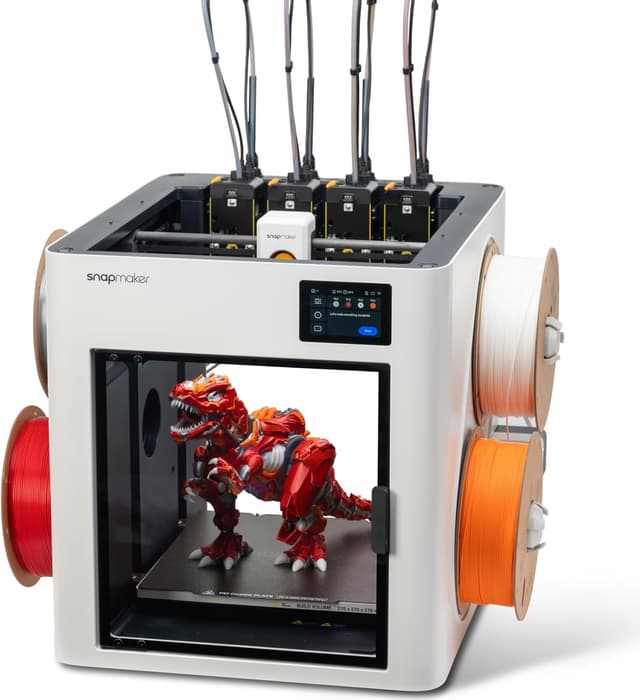
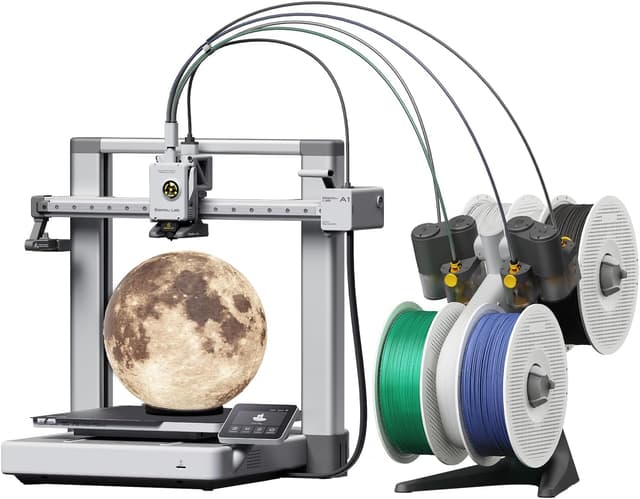
Both the Snapmaker U1 and the Bambu Lab A1 Combo made our Top 5 Multi-Color 3D Printers Under $1,000, at #3 and #5 (best budget). The most advanced multi-color mechanism here and the only toolchanger: four independent toolheads mean a color change is a tool swap rather than a purge, so multi-color prints waste a fraction of the filament the single-nozzle systems burn, and Tom's Hardware timed swaps at about 12 seconds. Unlike the X2D, whose second nozzle covers only a second color, it keeps all four colors purge-free. Each head runs its own temperature, which makes PLA with PETG supports and other true multi-material prints practical, and its 270 mm cube is the largest build volume in the list. It ranks third because it tops out at four colors, needs the optional top cover for ABS and ASA, and ships with stainless rather than hardened nozzles. It beats the Elegoo Centauri Carbon 2 Combo on purge waste, swap speed and multi-material flexibility, which outweighs the Elegoo's full enclosure and 350°C nozzle. The easiest and lowest-cost way into multi-color printing: full-auto calibration, the AMS lite and Bambu Studio's paint tools let a first-time owner print a four-color model with almost no tuning, and Tom's Hardware's reviewer named AMS lite their favorite multicolor system for its simplicity and reliability. It ranks last because it is an open-frame bed slinger (10,000 mm/s² acceleration against 20,000 on every other printer here), it suits PLA, PETG and TPU rather than ABS or ASA, and AMS lite cannot chain beyond four colors, dry filament or feed TPU. Choose it over the Centauri Carbon 2 Combo if you will print mostly PLA and value the Bambu Lab ecosystem over an enclosure.
We score multi-color 3d printers under $1,000 on Multi-Color System (30%), Print Quality & Speed (20%), Material Capability (15%), Ease of Use & Software (20%) and Value (15%). On that basis the Snapmaker U1 totals 8.3 out of 10 and the Bambu Lab A1 Combo 7.5. The widest gap is Multi-Color System, where the Snapmaker U1 scores 10 against 7 for the Bambu Lab A1 Combo: how many colors it handles out of the box and with expansion, how fast it changes color, how much filament each change purges, and how reliably reviewers found it swapping. Ease of Use & Software also separates them: 10 for the Bambu Lab A1 Combo versus 8 for the Snapmaker U1. The Bambu Lab A1 Combo claws back ground on Value.
On paper, the specifications that actually differ: Multi-Color System: SnapSwap toolchanger (4 independent toolheads) on the Snapmaker U1 versus AMS lite (single-nozzle filament swapping) on the Bambu Lab A1 Combo; Toolheads / Nozzles: 4 toolheads, 4 nozzles on the Snapmaker U1 versus 1 toolhead, 1 nozzle on the Bambu Lab A1 Combo; Build Volume: 270 × 270 × 270 mm on the Snapmaker U1 versus 256 × 256 × 256 mm on the Bambu Lab A1 Combo; Enclosure / Chamber: Open top; optional top cover for ABS/ASA on the Snapmaker U1 versus Open frame on the Bambu Lab A1 Combo; Weight: 18.2 kg on the Snapmaker U1 versus 8.3 kg printer (without AMS lite) on the Bambu Lab A1 Combo. They match on Max Colors, Filament Drying, Max Speed and Max Nozzle Temp.
Check current pricing at the merchant links below. Owners praise the Snapmaker U1 for near-zero purge waste from four dedicated toolheads and tool swaps of about 12 seconds in Tom's Hardware's timing; the most common complaint is an open top: ABS and ASA need the optional top cover, an extra purchase. Owners praise the Bambu Lab A1 Combo for the easiest setup here thanks to full-auto calibration and core-mounted spools in the AMS lite that accept more third-party spool sizes, including cardboard; the most common complaint is an open-frame bed slinger: not suited to ABS or ASA, and its 10,000 mm/s² acceleration is half that of the CoreXY printers here.
Snapmaker U1
- Near-zero purge waste from four dedicated toolheads
- Tool swaps of about 12 seconds in Tom's Hardware's timing
- Per-toolhead temperatures for genuine multi-material prints, such as PLA with PETG supports
- The largest build volume here (270 mm cube), with Klipper firmware, OrcaSlicer and RFID auto-feed
- An open top: ABS and ASA need the optional top cover, an extra purchase
- A hard limit of four colors, with no way to add more spools to a print
- Stainless-steel nozzles as standard; carbon- and glass-fiber filaments need hardened-steel nozzles bought separately
Bambu Lab A1 Combo
- The easiest setup here thanks to full-auto calibration
- Core-mounted spools in the AMS lite that accept more third-party spool sizes, including cardboard
- Bambu Studio's paint tools and the MakerWorld library of ready-to-print multi-color models
- The lowest price in this list
- An open-frame bed slinger: not suited to ABS or ASA, and its 10,000 mm/s² acceleration is half that of the CoreXY printers here
- AMS lite cannot be chained beyond four colors and has no filament drying
- AMS lite cannot feed TPU, so flexible filament needs a separate spool holder
Which should you buy?
The Snapmaker U1 is the better fit for multi-color prints with minimal filament waste and multi-material prints such as PLA with PETG supports; it is the higher-scoring pick here, chiefly for Multi-Color System and Material Capability. The Bambu Lab A1 Combo is the better fit for first-time and family multi-color printing in PLA and the lowest price of entry, and the stronger choice if Ease of Use & Software and Value matter more to you than the overall score. The Snapmaker U1 is a poor fit for more than four colors in one print; the Bambu Lab A1 Combo is a poor fit for printing ABS, ASA or other filaments that need an enclosure.
Choose the Snapmaker U1 if
- Multi-color prints with minimal filament waste
- Multi-material prints such as PLA with PETG supports
- Large prints with frequent color changes
Skip it if
- More than four colors in one print
- ABS or ASA without buying the top cover
Choose the Bambu Lab A1 Combo if
- First-time and family multi-color printing in PLA
- The lowest price of entry
- The Bambu Lab and MakerWorld ecosystem
Skip it if
- Printing ABS, ASA or other filaments that need an enclosure
- More than four colors in one print
Common questions
Is the Snapmaker U1 better than the Bambu Lab A1 Combo?
In our Multi-Color 3D Printers Under $1,000 ranking the Snapmaker U1 scores higher overall, 8.3 to 7.5, with the biggest advantage in Multi-Color System. The Bambu Lab A1 Combo is stronger on Ease of Use & Software and Value, so it is the better pick if those matter most to you.
What is the main difference between the Snapmaker U1 and the Bambu Lab A1 Combo?
The headline spec difference is Multi-Color System: SnapSwap toolchanger (4 independent toolheads) on the Snapmaker U1 versus AMS lite (single-nozzle filament swapping) on the Bambu Lab A1 Combo. In use, the gap that matters most is Multi-Color System (10 vs 7 in our scoring): how many colors it handles out of the box and with expansion, how fast it changes color, how much filament each change purges, and how reliably reviewers found it swapping.