Samsung Odyssey OLED G9 G93SC vs Alienware AW3425DW
Samsung Odyssey OLED G9 G93SC (#1, best overall) vs Alienware AW3425DW (#3): in our Ultrawide Gaming Monitors scoring the Samsung Odyssey OLED G9 G93SC totals 9.5/10 and the Alienware AW3425DW 9.4/10.
We may earn a commission when you buy through our links.
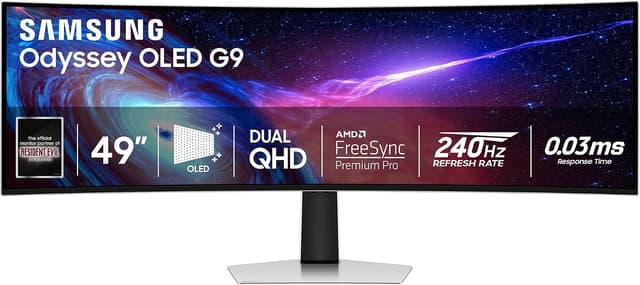
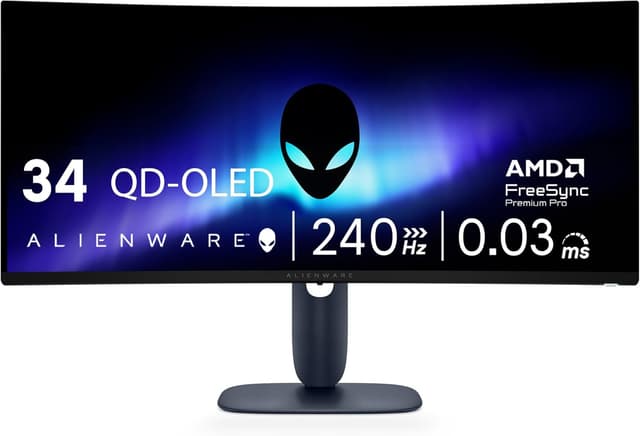
TopsFive comparison scores
Side by side
| Samsung Odyssey OLED G9 G93SC | Alienware AW3425DW | |
|---|---|---|
| Screen Size | 49" 32:9, 1800R curve | 34.2" 21:9, 1800R curve |
| Resolution | 5120x1440 | 3440x1440 |
| Refresh Rate | 240Hz | 240Hz |
| Panel | QD-OLED | QD-OLED |
| Response Time | 0.03ms GtG | 0.03ms GtG |
| HDR | DisplayHDR True Black 400 | DisplayHDR True Black 400 |
| Adaptive Sync | — | FreeSync Premium Pro, G-Sync Compatible |
| Inputs | — | 1x DisplayPort 1.4 (DSC), 2x HDMI 2.1 |
| Stand | — | Height / tilt / swivel |
| Price | Check price → | Check price → |
How they differ in real use
Built from our ultrawide gaming monitors scoring, each product's published specifications, and verified owner feedback — not hands-on testing.
Both the Samsung Odyssey OLED G9 G93SC and the Alienware AW3425DW made our Top 5 Ultrawide Gaming Monitors, at #1 (best overall) and #3. The most immersive screen here: a 49" 32:9 QD-OLED at 5120x1440 and 240Hz with 0.03ms response, equal to two 27" 1440p monitors side by side and wider than the LG 45GR95QE's 45" 3440x1440 canvas. It is the same panel as the G95SC it replaces in this ranking, minus the smart TV apps and remote, which costs it a little on features but nothing on picture or speed. The trade-offs are a desk footprint of about 1.2 m, OLED burn-in risk and patchy 32:9 support in some games. A generation newer than the AW3423DWF below it: the same 34" 3440x1440 QD-OLED format with an 1800R curve, but at 240Hz instead of 165Hz with a 0.03ms response, plus two HDMI 2.1 inputs and both FreeSync Premium Pro and G-Sync Compatible certification. PCGamesN scores it 9/10 and singles out text far sharper than early QD-OLED panels, and RTINGS reports near-instantaneous response times at any refresh rate. It sits below the 45" LG on sheer size and immersion and costs more than the AW3423DWF, and it has no USB-C video input or KVM switch; in a bright room its blacks take on a purple tint.
We score ultrawide gaming monitors on Immersion (30%), Image Quality (25%), Speed (25%), Features (10%) and Value (10%). On that basis the Samsung Odyssey OLED G9 G93SC totals 9.5 out of 10 and the Alienware AW3425DW 9.4. The widest gap is Immersion, where the Samsung Odyssey OLED G9 G93SC scores 10 against 9 for the Alienware AW3425DW: curve and aspect ratio. Value also separates them: 8.5 for the Alienware AW3425DW versus 7 for the Samsung Odyssey OLED G9 G93SC.
On paper, the specifications that actually differ: Screen Size: 49" 32:9, 1800R curve on the Samsung Odyssey OLED G9 G93SC versus 34.2" 21:9, 1800R curve on the Alienware AW3425DW; Resolution: 5120x1440 on the Samsung Odyssey OLED G9 G93SC versus 3440x1440 on the Alienware AW3425DW. They match on Refresh Rate, Panel, Response Time and HDR.
Check current pricing at the merchant links below. Owners praise the Samsung Odyssey OLED G9 G93SC for 49" QD-OLED 32:9 at 5120x1440 and 240Hz with 0.03ms GtG response; the most common complaint is no smart TV apps or remote: streaming needs a separate device. Owners praise the Alienware AW3425DW for 34" QD-OLED at 3440x1440 and 240Hz and 0.03ms GtG response with near-instantaneous transitions at any refresh rate (RTINGS); the most common complaint is blacks look purplish and glare is hard to control in a bright room.
Samsung Odyssey OLED G9 G93SC
- 49" QD-OLED 32:9 at 5120x1440
- 240Hz with 0.03ms GtG response
- DisplayHDR True Black 400 and FreeSync Premium Pro
- 1800R curve with height-adjustable stand
- No smart TV apps or remote: streaming needs a separate device
- About 1.2 m (3 ft 11 in) wide, so it needs a large desk
- Not all games support 32:9
Alienware AW3425DW
- 34" QD-OLED at 3440x1440 and 240Hz
- 0.03ms GtG response with near-instantaneous transitions at any refresh rate (RTINGS)
- DisplayHDR True Black 400 with a rated 1,000-nit peak in small highlights
- FreeSync Premium Pro and G-Sync Compatible certified
- Blacks look purplish and glare is hard to control in a bright room
- Full-screen SDR brightness of about 250 nits trails LCD monitors
- No USB-C video input, KVM switch or built-in speakers
Which should you buy?
The Samsung Odyssey OLED G9 G93SC is the better fit for sim racing/flight sims and productivity + gaming on one screen; it is the higher-scoring pick here, chiefly for Immersion and Speed. The Alienware AW3425DW is the better fit for single-player and sim gamers who want fast OLED motion and upgraders from a 165-175Hz QD-OLED ultrawide, and the stronger choice if Value matters more to you than the overall score. The Samsung Odyssey OLED G9 G93SC is a poor fit for competitive esports; the Alienware AW3425DW is a poor fit for bright, sunlit rooms.
Choose the Samsung Odyssey OLED G9 G93SC if
- Sim racing/flight sims
- Productivity + gaming on one screen
- Those replacing dual monitors
Skip it if
- Competitive esports
- Small desks
Choose the Alienware AW3425DW if
- Single-player and sim gamers who want fast OLED motion
- Upgraders from a 165-175Hz QD-OLED ultrawide
- Setups that need two HDMI 2.1 inputs for a PC and a console
Skip it if
- Bright, sunlit rooms
- Buyers who need USB-C laptop charging or a KVM switch
Common questions
Is the Samsung Odyssey OLED G9 G93SC better than the Alienware AW3425DW?
In our Ultrawide Gaming Monitors ranking the Samsung Odyssey OLED G9 G93SC scores higher overall, 9.5 to 9.4, with the biggest advantage in Immersion. The Alienware AW3425DW is stronger on Value, so it is the better pick if that matters most to you.
What is the main difference between the Samsung Odyssey OLED G9 G93SC and the Alienware AW3425DW?
The headline spec difference is Screen Size: 49" 32:9, 1800R curve on the Samsung Odyssey OLED G9 G93SC versus 34.2" 21:9, 1800R curve on the Alienware AW3425DW. In use, the gap that matters most is Immersion (10 vs 9 in our scoring): curve and aspect ratio.