Samsung Odyssey OLED G8 G80SH 32" vs ASUS ROG Swift PG32UCDM
Samsung Odyssey OLED G8 G80SH 32" (#1, best overall) vs ASUS ROG Swift PG32UCDM (#2, best premium): in our 4K Gaming Monitors scoring the Samsung Odyssey OLED G8 G80SH 32" totals 9.6/10 and the ASUS ROG Swift PG32UCDM 9.5/10.
We may earn a commission when you buy through our links.
TopsFive comparison scores
Side by side
| Samsung Odyssey OLED G8 G80SH 32" | ASUS ROG Swift PG32UCDM | |
|---|---|---|
| Screen Size | 31.5" flat | — |
| Resolution | 3840x2160 | 3840x2160 |
| Refresh Rate | 240Hz | 240Hz |
| Panel | QD-OLED | QD-OLED |
| Response Time | 0.03ms GtG | 0.03ms GtG |
| HDR | DisplayHDR True Black 500 | HDR True Black 400 |
| Adaptive Sync | FreeSync Premium Pro, G-Sync Compatible | — |
| Inputs | 1x DisplayPort 2.1 (UHBR20), 2x HDMI 2.1, 1x USB-C (98W) | — |
| Stand | Height / tilt / swivel / pivot | — |
| Screen Finish | Matte (Glare Free) | — |
| Price | Check price → | Check price → |
How they differ in real use
Built from our 4k gaming monitors scoring, each product's published specifications, and verified owner feedback — not hands-on testing.
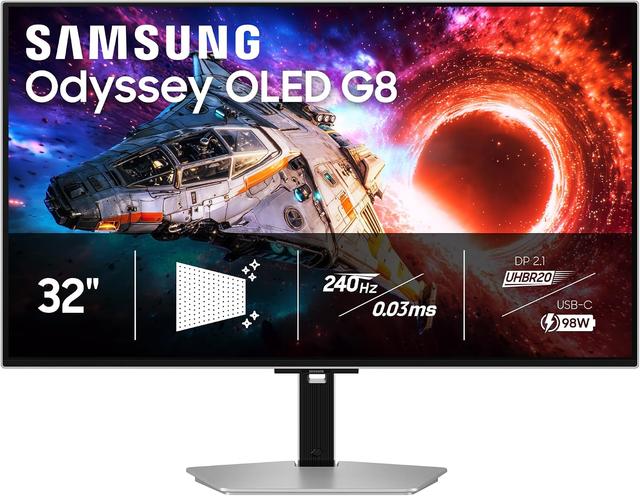
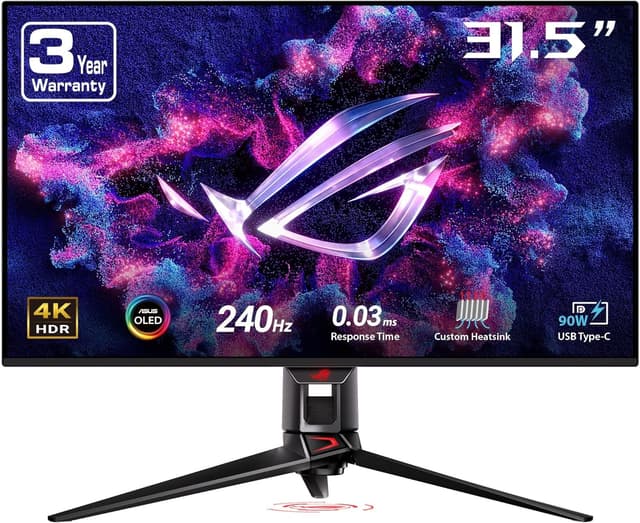
Both the Samsung Odyssey OLED G8 G80SH 32" and the ASUS ROG Swift PG32UCDM made our Top 5 4K Gaming Monitors, at #1 (best overall) and #2 (best premium). The 2026 successor to the Odyssey OLED G8 G80SD that used to hold this spot (Amazon no longer sells the G80SD new). It keeps the 31.5" 4K QD-OLED format at 240Hz with a 0.03ms response, but steps up to VESA DisplayHDR True Black 500 where every other OLED in this list is certified True Black 400, and adds DisplayPort 2.1 (UHBR20) alongside two HDMI 2.1 inputs and 98W USB-C. RTINGS names it the best Samsung monitor it has reviewed and finds its matte Glare Free coating handles reflections much better than the glossy MSI MPG 321URX. The higher HDR certification and DisplayPort 2.1 bandwidth put it ahead of the ASUS PG32UCDM; the trade-offs are a hazier image and purple-tinted blacks in a bright room, some VRR flicker in dark games, and no speakers, smart TV apps or KVM switch. ASUS's flagship pairs 32" 4K QD-OLED with 240Hz refresh, excellent uniformity, and premium build quality. Custom heatsink extends OLED longevity.
We score 4k gaming monitors on Image Quality (35%), Speed (25%), Features (20%), Panel Quality (10%) and Value (10%). On that basis the Samsung Odyssey OLED G8 G80SH 32" totals 9.6 out of 10 and the ASUS ROG Swift PG32UCDM 9.5. The widest gap is Image Quality, where the Samsung Odyssey OLED G8 G80SH 32" scores 10 against 9.8 for the ASUS ROG Swift PG32UCDM: resolution and HDR. Features also separates them: 9.8 for the ASUS ROG Swift PG32UCDM versus 9.5 for the Samsung Odyssey OLED G8 G80SH 32". The ASUS ROG Swift PG32UCDM claws back ground on Panel Quality.
On paper, the specifications that actually differ: HDR: DisplayHDR True Black 500 on the Samsung Odyssey OLED G8 G80SH 32" versus HDR True Black 400 on the ASUS ROG Swift PG32UCDM. They match on Resolution, Refresh Rate, Panel and Response Time.
Check current pricing at the merchant links below. Owners praise the Samsung Odyssey OLED G8 G80SH 32" for 31.5" 4K QD-OLED at 240Hz with a 0.03ms GtG response and VESA DisplayHDR True Black 500 and HDR10+ Gaming, with a rated 1,000-nit peak at a 3% window; the most common complaint is blacks look purple and the matte film adds haze in a bright room (RTINGS). Owners praise the ASUS ROG Swift PG32UCDM for 4K 240Hz QD-OLED and custom heatsink for longevity; the most common complaint is among most expensive.
Samsung Odyssey OLED G8 G80SH 32"
- 31.5" 4K QD-OLED at 240Hz with a 0.03ms GtG response
- VESA DisplayHDR True Black 500 and HDR10+ Gaming, with a rated 1,000-nit peak at a 3% window
- Matte Glare Free coating that RTINGS reports handles reflections much better than glossy QD-OLEDs
- DisplayPort 2.1 (UHBR20), two HDMI 2.1 inputs and USB-C with 98W charging
- Blacks look purple and the matte film adds haze in a bright room (RTINGS)
- RTINGS reports some VRR flicker in dark games when frame rates swing
- No built-in speakers, smart TV apps or KVM switch
ASUS ROG Swift PG32UCDM
- 4K 240Hz QD-OLED
- Custom heatsink for longevity
- Excellent uniformity
- ROG aesthetic
- Among most expensive
- OLED burn-in risk
- Glossy panel
Which should you buy?
The Samsung Odyssey OLED G8 G80SH 32" is the better fit for 4K OLED gaming in rooms with windows or overhead lights and PC players with a DisplayPort 2.1 graphics card; it is the higher-scoring pick here, chiefly for Image Quality and Value. The ASUS ROG Swift PG32UCDM is the better fit for premium 4K gaming and ASUS ecosystem users, and the stronger choice if Features and Panel Quality matter more to you than the overall score. The Samsung Odyssey OLED G8 G80SH 32" is a poor fit for bright rooms where the deepest blacks matter most; the ASUS ROG Swift PG32UCDM is a poor fit for budget builds.
Choose the Samsung Odyssey OLED G8 G80SH 32" if
- 4K OLED gaming in rooms with windows or overhead lights
- PC players with a DisplayPort 2.1 graphics card
- Laptop users who want single-cable USB-C charging
Skip it if
- Bright rooms where the deepest blacks matter most
- Buyers who want built-in speakers or smart TV apps
Choose the ASUS ROG Swift PG32UCDM if
- Premium 4K gaming
- ASUS ecosystem users
- Those wanting best uniformity
Skip it if
- Budget builds
- Small desk users
Common questions
Is the Samsung Odyssey OLED G8 G80SH 32" better than the ASUS ROG Swift PG32UCDM?
In our 4K Gaming Monitors ranking the Samsung Odyssey OLED G8 G80SH 32" scores higher overall, 9.6 to 9.5, with the biggest advantage in Image Quality. The ASUS ROG Swift PG32UCDM is stronger on Features and Panel Quality, so it is the better pick if those matter most to you.
What is the main difference between the Samsung Odyssey OLED G8 G80SH 32" and the ASUS ROG Swift PG32UCDM?
The headline spec difference is HDR: DisplayHDR True Black 500 on the Samsung Odyssey OLED G8 G80SH 32" versus HDR True Black 400 on the ASUS ROG Swift PG32UCDM. In use, the gap that matters most is Image Quality (10 vs 9.8 in our scoring): resolution and HDR.