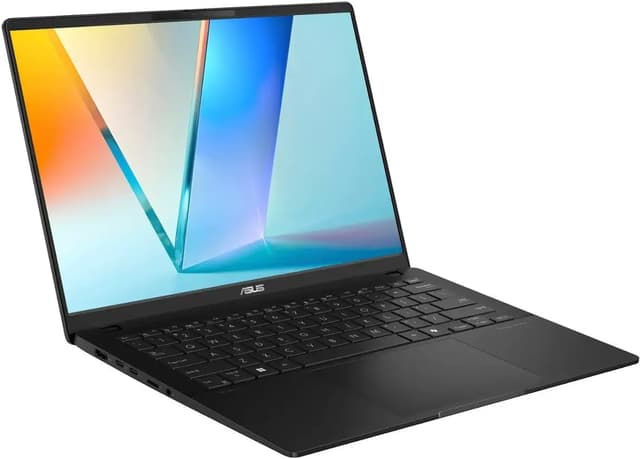
MacBook Neo vs ASUS Vivobook S 14 OLED
MacBook Neo (#2, best value) vs ASUS Vivobook S 14 OLED (#3): in our Student Laptops scoring the MacBook Neo totals 9/10 and the ASUS Vivobook S 14 OLED 8.3/10, the MacBook Neo leading on Value and Portability.
We may earn a commission when you buy through our links.

TopsFive comparison scores
Side by side
| MacBook Neo | ASUS Vivobook S 14 OLED | |
|---|---|---|
| OS | macOS | Windows 11 Home |
| Processor | Apple A18 Pro (6-core CPU) | Intel Core Ultra 5 226V |
| RAM | 8GB unified memory | 16GB LPDDR5X (on board) |
| Storage | 256GB SSD | 512GB PCIe SSD |
| GPU | Apple A18 Pro (5-core GPU) | Intel Arc 130V (integrated) |
| Display | 13" Liquid Retina 2408x1506 | 14" OLED WUXGA 1920x1200 |
| Weight | 2.7 lbs | 2.87 lbs |
| Battery | 36.5Wh, up to 16 hours (video streaming) | 75Wh |
| Ports | 1x USB-C (USB 3, 10Gb/s, DisplayPort), 1x USB-C (USB 2), 3.5mm headphone jack | 2x Thunderbolt 4, HDMI, microSD reader, 3.5mm audio |
| Wireless | Wi-Fi 6E, Bluetooth 6 | Wi-Fi 7, Bluetooth 5.4 |
| Camera | 1080p FaceTime HD | — |
| Price | Check price → | Check price → |
How they differ in real use
Built from our student laptops scoring, each product's published specifications, and verified owner feedback — not hands-on testing.
Both the MacBook Neo and the ASUS Vivobook S 14 OLED made our Top 5 Student Laptops, at #2 (best value) and #3. The MacBook Neo is the value pick for students who want macOS: it brings an aluminum MacBook build, a 13-inch 500-nit display, Apple-rated battery life of up to 16 hours of video streaming and a 2.7 lb weight to Apple's lowest laptop price. Its fixed 8GB of memory and USB 2 second port are the trade-offs that keep it behind the MacBook Air M5. The Vivobook S 14 OLED is the strongest Windows pick here for long campus days: its Core Ultra 5 226V, 16GB of memory and 75Wh battery come in a 2.87 lb chassis that is about a pound lighter than the 15.6-inch Aspire 5 and 16-inch OmniBook 5, with a higher-contrast 14-inch OLED display than either.
We score student laptops on Value (30%), Battery Life (25%), Portability (20%), Performance (15%) and Build Quality (10%). On that basis the MacBook Neo totals 9 out of 10 and the ASUS Vivobook S 14 OLED 8.3. The widest gap is Value, where the MacBook Neo scores 9.5 against 8.5 for the ASUS Vivobook S 14 OLED: performance per dollar. Portability also separates them: 9.5 for the MacBook Neo versus 8.5 for the ASUS Vivobook S 14 OLED.
On paper, the specifications that actually differ: Operating System: macOS on the MacBook Neo versus Windows 11 Home on the ASUS Vivobook S 14 OLED; CPU: Apple A18 Pro (6-core CPU) on the MacBook Neo versus Intel Core Ultra 5 226V on the ASUS Vivobook S 14 OLED; RAM: 8GB unified memory on the MacBook Neo versus 16GB LPDDR5X (on board) on the ASUS Vivobook S 14 OLED; Storage: 256GB SSD on the MacBook Neo versus 512GB PCIe SSD on the ASUS Vivobook S 14 OLED; GPU: Apple A18 Pro (5-core GPU) on the MacBook Neo versus Intel Arc 130V (integrated) on the ASUS Vivobook S 14 OLED; Display: 13" Liquid Retina 2408x1506 on the MacBook Neo versus 14" OLED WUXGA 1920x1200 on the ASUS Vivobook S 14 OLED.
Check current pricing at the merchant links below. Owners praise the MacBook Neo for aluminum MacBook build at Apple's lowest laptop price and A18 Pro chip handles browser-heavy coursework, office apps and light photo editing; the most common complaint is 8GB of memory is fixed and cannot be upgraded. Owners praise the ASUS Vivobook S 14 OLED for 14" WUXGA (1920x1200) OLED display and large 75Wh battery paired with the power-efficient Core Ultra 5 226V; the most common complaint is 16GB of memory is soldered, with no upgrade path.
MacBook Neo
- Aluminum MacBook build at Apple's lowest laptop price
- A18 Pro chip handles browser-heavy coursework, office apps and light photo editing
- Apple rates the battery for up to 16 hours of video streaming and 11 hours of web browsing
- 2.7 lbs with a 13-inch, 500-nit display
- 8GB of memory is fixed and cannot be upgraded
- One of its two USB-C ports runs at USB 2 speeds
- Touch ID is reserved for the 512GB configuration; this 256GB model does without it
ASUS Vivobook S 14 OLED
- 14" WUXGA (1920x1200) OLED display
- Large 75Wh battery paired with the power-efficient Core Ultra 5 226V
- 16GB LPDDR5X memory standard
- 2.87 lbs
- 16GB of memory is soldered, with no upgrade path
- 60Hz refresh rate
- Integrated Intel Arc graphics are not meant for demanding games or 3D work
Which should you buy?
The MacBook Neo is the better fit for students on a budget who want macOS and note-taking and coursework; it is the higher-scoring pick here, chiefly for Value and Portability. The ASUS Vivobook S 14 OLED is the better fit for students wanting OLED and all-day battery on campus. The MacBook Neo is a poor fit for heavy video or 3D work; the ASUS Vivobook S 14 OLED is a poor fit for gamers.
Choose the MacBook Neo if
- Students on a budget who want macOS
- Note-taking and coursework
- Long days on campus
Skip it if
- Heavy video or 3D work
- Students who need more than 8GB of memory
Choose the ASUS Vivobook S 14 OLED if
- Students wanting OLED
- All-day battery on campus
- Windows users
Skip it if
- Gamers
- Buyers who want upgradeable memory
Common questions
Is the MacBook Neo better than the ASUS Vivobook S 14 OLED?
In our Student Laptops ranking the MacBook Neo scores higher overall, 9 to 8.3, with the biggest advantage in Value. The ASUS Vivobook S 14 OLED does not out-score it on any criterion we weigh.
What is the main difference between the MacBook Neo and the ASUS Vivobook S 14 OLED?
The headline spec difference is Operating System: macOS on the MacBook Neo versus Windows 11 Home on the ASUS Vivobook S 14 OLED. In use, the gap that matters most is Value (9.5 vs 8.5 in our scoring): performance per dollar.